Recent Posts
Why Does Hair Fall Increase During Summer Season?
Aug 25, 2026Everything You Need to Know About Beard Transplant
Growing a thick, well-shaped beard has become a symbol of confidence and style for many men. While some naturally develop a full beard, others struggle with patchy growth, uneven density, or complete absence of facial hair due to genetics, scars, burns, or certain medical conditions.
If you've tried beard oils, supplements, or home remedies without seeing the results you expected, you may have come across beard transplantation as a permanent solution.
But what exactly is a beard transplant? Is it permanent? Does it look natural? How long does it take to heal? And how much does it cost?
If you're searching for:
- Know About Beard Transplant
- facial hair transplant procedure
- beard transplant results
- beard hair restoration cost
- patch beard treatment options
- how long does beard transplant take to heal
- best beard transplant clinic in Surat
- donor area hair grafts
- facial hair growth tips
- patchy beard solution
This comprehensive guide answers all your questions.
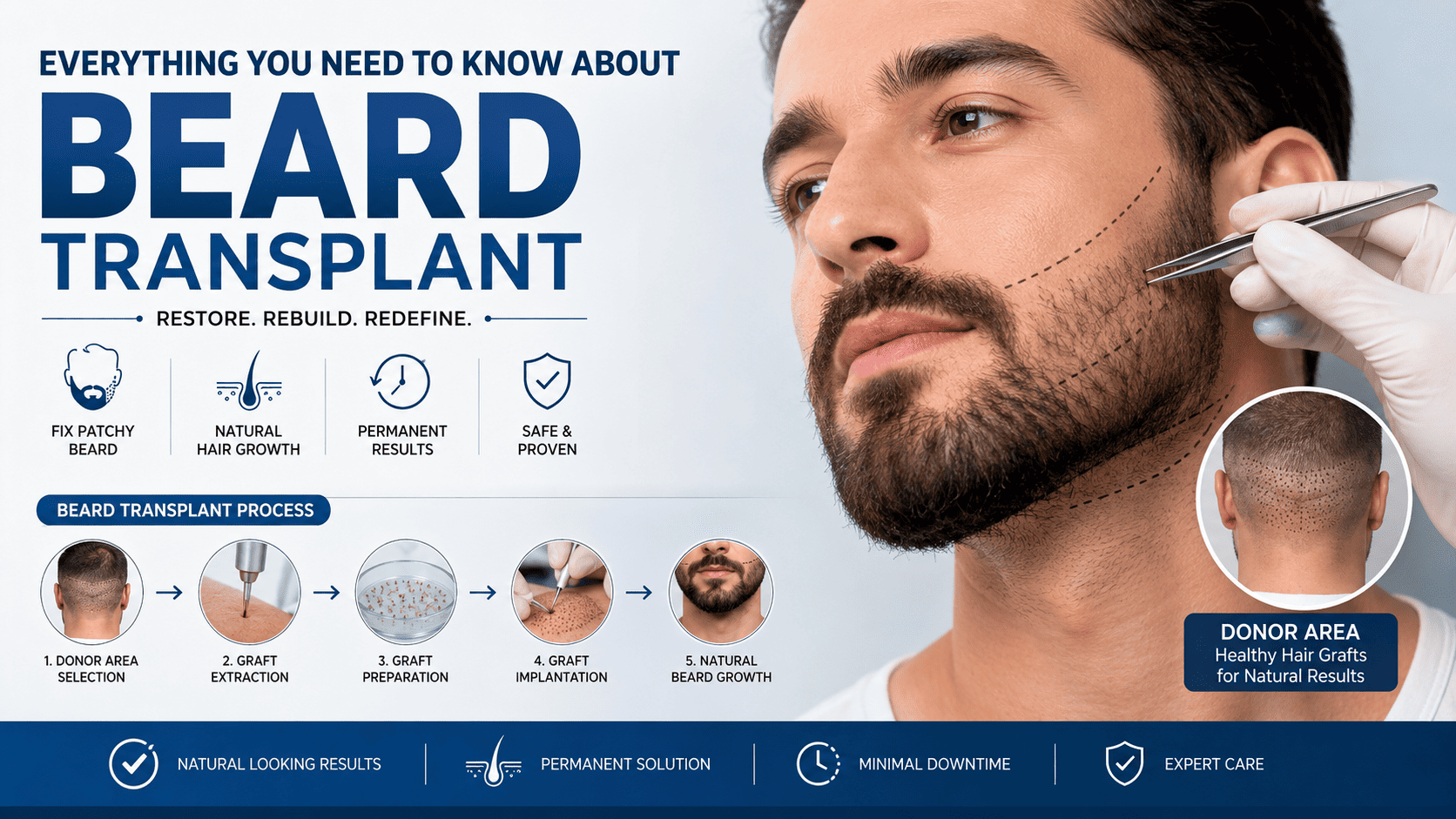
A beard transplant is a permanent facial hair restoration procedure in which healthy hair follicles are taken from the back of the scalp (donor area) and implanted into areas of the beard with little or no hair. Modern FUE beard transplantation provides natural-looking, permanent results when performed by an experienced surgeon.
Why Can't Some Men Grow a Full Beard?
Some men may have:
- Sparse beard growth
- Patchy cheeks
- Missing sideburns
- Thin moustache
- Uneven beard density
| Cause | Can It Affect Beard Growth? |
| Genetics | Most common |
| Scars or burns | Yes |
| Alopecia areata | Yes |
| Hormonal disorders | Occasionally |
| Previous surgery | Possible |
If follicles are absent, no cream or oil can create new beard hair.
What Is a Beard Transplant?
Healthy hair follicles are carefully extracted from the donor area hair grafts — typically the back and sides of the scalp — and implanted into areas of the face that require more density.
Because your own hair is used, the transplanted beard grows naturally and permanently.
Who Is a Good Candidate for a Beard Transplant?
- Naturally patchy beard
- Thin facial hair
- Uneven beard growth
- Beard scars
- Burn scars
- Hair loss due to injury
- Previous unsuccessful beard transplant
- Good donor hair density
Patch Beard Treatment Options
| Treatment | Best For | Permanent? |
| Beard oils | Cosmetic appearance | No |
| Nutrition improvement | Deficiencies | No |
| Minoxidil | Mild patchiness with existing follicles | Sometimes |
| PRP Therapy | Selected cases with weak follicles | Limited evidence |
| Beard Transplant | Missing or absent follicles | Yes |
If follicles are completely absent, a beard transplant remains the most predictable long-term solution.
Facial Hair Growth Tips
Healthy Habits That Support Beard Growth
- Eat adequate protein (hair is primarily made of keratin)
- Maintain sufficient iron, zinc, vitamin D, and vitamin B12 levels
- Exercise regularly
- Sleep 7–8 hours daily
- Manage stress
- Keep facial skin clean and moisturized
- Avoid smoking
Lifestyle changes improve the quality of existing beard hair but cannot create new follicles in areas where they do not naturally exist.
Facial Hair Transplant Procedure: Step by Step
Procedure Overview
Consultation
↓
Beard Design
↓
Donor Area Assessment
↓
Local Anesthesia
↓
FUE Graft Extraction
↓
Graft Preparation
↓
Recipient Site Creation
↓
Hair Implantation
↓
Recovery
The surgeon pays special attention to the angle, direction, and density of every implanted graft because facial hair grows differently in each region of the face.
How RQC Performs a Beard Hair Transplant
Extraction is carried out as a two-step process — first separating each follicle from the donor zone using high-quality instruments to keep the transection (failure) rate low, then carefully removing and storing the grafts in a sterile, temperature-controlled environment before implantation.
For creating the recipient channels, Dr. Vivek Galani uses Sapphire FUE — a technique he brought to India from Turkey in 2020 after being awarded for it by Dr. Tayfun Oguzhoglu. He was also awarded by Dr. Laura Caicedo of Spain in 2022 for performing an advanced beard hair transplant, reflecting the internationally trained expertise behind every beard hair transplant procedure at RQC.
Why the Donor Area Matters
Healthy follicles are usually harvested from the back of the scalp, where hair is genetically more resistant to hormonal hair loss.
Why These Hair Grafts Are Preferred
- High survival rate
- Similar thickness
- Long-term permanence
- Reliable growth
Beard Hair Restoration Cost
Factors affecting cost include:
- Number of grafts required
- Size of the beard area
- Density goals
- Complexity of design
- Surgeon's experience
- Clinic infrastructure
| Area | Typical Grafts |
| Small patch | 200–500 |
| Partial beard | 500–1,200 |
| Full beard restoration | 1,500–3,000 |
A consultation allows your surgeon to estimate the exact graft requirement and treatment plan.
At RQC, you can start with a free hair assessment form or book a dedicated 1-to-1 video consultation with Dr. Vivek Galani (₹799) to get a personalised beard hair transplant cost estimate based on your goals and donor availability. An EMI facility is also available for patients who need financial flexibility for their beard transplant cost.
Beard Transplant Results: What to Expect
Newly transplanted hairs follow a normal hair growth cycle.
Beard Transplant Results Timeline
| Time After Procedure | Expected Changes |
| First week | Healing and crust formation |
| 2–4 weeks | Temporary shedding of transplanted hairs |
| 3–4 months | New beard growth begins |
| 6–8 months | Noticeable increase in density |
| 12 months | Final beard transplant results |
Temporary shedding is expected and does not mean the grafts have failed.
How Long Does a Beard Transplant Take to Heal?
Healing Timeline
| Recovery Stage | Typical Duration |
| Mild redness | 3–7 days |
| Tiny scabs | 7–10 days |
| Most visible healing | 10–14 days |
| Complete graft stabilization | Around 2 weeks |
| Final cosmetic results | 9–12 months |
Following your surgeon's aftercare instructions significantly improves healing.
Does a Beard Transplant Look Natural?
Natural-looking results depend on:
- Proper beard design
- Correct graft angle
- Appropriate density
- Symmetrical placement
- Surgeon experience
Beard Transplant Side Effects and Risks
More significant risks — such as infection, scarring, or uneven growth — are rare and can be minimized with proper technique and aftercare.
Cobble-Stoning (Hair Bumps) After a Beard Transplant — Causes
- Improper graft placement depth — grafts sitting too close to or too deep below the skin's surface
- Over-dense grafting, which can cause uneven healing and small raised areas
- Thick graft size or excess surrounding tissue that doesn't sit smoothly in the recipient area
- Individual skin type and healing response, including a tendency toward thicker scar tissue
- Inflammation or minor infection during healing
- Suboptimal surgical technique in graft angle, direction, or distribution
- Poor wound healing or excessive scarring, sometimes worsened by picking at scabs
How to Prevent or Minimize Cobble-Stoning
- Choose an experienced surgeon who understands correct graft placement depth, density, and direction.
- Follow all post-procedure care instructions closely, including avoiding scratching or picking at scabs
- If cobble-stoning does occur, treatments such as microneedling, laser therapy, corticosteroid injections, or revision surgery can improve skin texture
Choosing the Best Beard Transplant Clinic in Surat
Checklist Before Choosing a Clinic
- ✔ Experienced hair transplant surgeon
- ✔ Doctor-led beard design
- ✔ FUE expertise
- ✔ Natural before-and-after results
- ✔ Transparent discussion of graft numbers
- ✔ Comprehensive aftercare program
Why RQC Hair Transplant Clinic Is a Trusted Choice for Beard Hair Transplant in Surat
Beyond the surgeon's expertise, RQC's beard hair transplant patients benefit from:
- Sapphire micro-blade technology for minimal tissue trauma and faster healing
- A NABH-accredited, sterile facility using single-use instruments
- Swelling incidence kept below 1% through advanced post-op technique
- CareBuddy support provided from the day of the procedure through recovery
- Two clinic locations for beard hair transplant patients — Surat (Varachha) and Ahmedabad (Naroda)
Myth vs Fact
| Myth | Fact |
| Beard oils can grow hair in bald patches | Oils improve conditioning but cannot create new follicles. |
| Beard transplants look fake | Modern FUE techniques can produce highly natural results. |
| The procedure is extremely painful | Local anesthesia keeps patients comfortable during surgery. |
| Transplanted beard hair cannot be shaved | Once healed, it can be trimmed and shaved like natural beard hair. |
Final Thoughts
Healthy habits and facial hair growth tips can improve existing beard quality, but they cannot create new hair follicles. For men with naturally sparse facial hair, scars, or missing beard areas, a facial hair transplant procedure offers a reliable and permanent solution.
The key to achieving excellent beard transplant results lies in careful planning, artistic design, appropriate donor area management, and choosing an experienced surgeon who understands both the science and aesthetics of facial hair restoration.
If you're exploring a beard hair transplant is long-lasting solution in Surat, Dr. Vivek Galani and the team at RQC Hair Transplant Clinic offer a free hair assessment and a dedicated 1-to-1 video consultation to help you plan the right approach for your face and goals.
