Recent Posts
Which Hair Transplant Method Gives Better Long-Term Results?
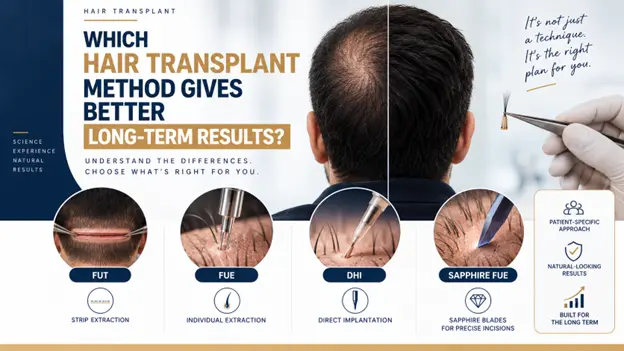
If you are considering a hair transplant, you will probably encounter several terms: FUE, FUT, DHI, Sapphire FUE, and sometimes even claims that one technique provides more density, better graft survival, or more permanent results than all others.
But which is actually the best hair transplant technique for long-term results?
The answer is more nuanced than simply choosing FUE over DHI or Sapphire over conventional FUE.
Long-term hair transplant success depends primarily on correct patient selection, donor management, graft handling, hairline planning, implantation technique, and management of future hair loss, not simply the name of the technique.
Let's understand the differences between these hair transplant methods.
What Determines Long-Term Hair Transplant Results?
A hair transplant works by relocating suitable follicles from the donor area, usually the back and sides of the scalp, to areas affected by hair loss.
Regardless of the technique used, long-term results depend on several factors:
- Quality of the donor area
- Correct graft extraction
- Minimal trauma to follicles
- Appropriate graft storage
- Natural hairline planning
- Correct angle and direction
- Appropriate density
- Careful implantation
- Patient factors
- Progression of existing hair loss
Therefore:
Technique + Planning + Surgical Execution + Donor Management + Future Hair-Loss Management = Long-Term Result
Understanding FUE, FUT, DHI and Sapphire FUE
Before comparing hair transplant methods, it is important to understand what these terms actually mean.
| Method | What It Mainly Refers To |
| FUT | Removing a strip of donor scalp and dissecting follicular units |
| FUE | Individually extracting follicular units |
| DHI | Commonly refers to implantation using an implanter device |
| Sapphire FUE | FUE combined with recipient sites created using sapphire blades |
This distinction is important because extraction and implantation are different stages of hair transplantation.
DHI, for example, is often marketed as an entirely different hair-transplant procedure, although grafts may still be harvested using FUE.
How Does FUE Hair Transplant Work?
In Follicular Unit Extraction (FUE), follicular units are individually removed from the donor area using small punches.
The grafts are then prepared and implanted into the recipient area.
Advantages of FUE
- No linear strip scar
- Small, distributed extraction scars
- Suitable for shorter hairstyles in many patients
- Individual follicular-unit harvesting
- Flexible graft selection
Limitations
Poorly planned FUE can result in donor overharvesting.
Removing too many follicles or extracting them unevenly may leave the donor area looking thin or patchy.
Therefore, FUE being minimally invasive does not mean donor management becomes less important.
How Does FUT Hair Transplant Work?
In Follicular Unit Transplantation (FUT), a strip of scalp containing healthy follicles is surgically removed from the donor area.
The strip is then dissected into individual follicular units for transplantation.
Potential Advantages
FUT may allow a large number of grafts to be obtained while preserving surrounding donor hair in appropriately selected patients.
Main Limitation
It leaves a linear donor scar.
The visibility of that scar depends on healing, surgical technique, hairstyle, and individual characteristics.
For patients who prefer very short hairstyles, this can be an important consideration.
What Is DHI Hair Transplant?
DHI, often called Direct Hair Implantation, typically refers to using an implanter device to place grafts into the recipient area.
The follicles themselves may still have been extracted using FUE.
This means comparing FUE vs DHI hair transplant is not always an apples-to-apples comparison.
FUE primarily describes how grafts are extracted, while DHI commonly describes how grafts are implanted.
What Is Sapphire FUE?
In Sapphire FUE, grafts are generally harvested using FUE.
The term "Sapphire" usually refers to sapphire blades used when creating recipient sites.
So the basic process is:
FUE Extraction
↓
Graft Preparation & Storage
↓
Recipient Sites Created With Sapphire Blades
↓
Graft Implantation
Sapphire blades are designed to allow precise recipient-site creation, but using sapphire alone does not guarantee superior results.
The surgeon still has to determine:
- Hairline
- Density
- Angle
- Direction
- Graft distribution
- Recipient-site depth
The tool cannot make these decisions by itself.
FUE vs FUT vs DHI Comparison: Which Gives Better Results?
There is no universal winner.
Each technique has advantages and limitations depending on the patient.
| Factor | FUE | FUT | DHI |
| Individual graft extraction | Yes | No, strip harvested first | Usually, FUE extraction |
| Linear scar | No | Yes | Depends on extraction method |
| Tiny extraction scars | Yes | No | Usually if FUE is used |
| Implanter required | No | No | Commonly yes |
| Short hairstyle flexibility | Generally better | More limited by linear scar | Similar to extraction method |
| Natural results possible | Yes | Yes | Yes |
| Long-term growth possible | Yes | Yes | Yes |
The important point is that all three approaches can produce excellent long-term results when performed correctly in an appropriate patient.
Which Hair Transplant Method Lasts the Longest?
Patients frequently ask whether FUE, FUT, or DHI lasts longer, or whether one specific technique lasts longest overall.
The longevity of transplanted follicles depends more on the biological characteristics of the donor follicles and how safely they are transplanted than on the marketing name attached to the procedure.
Appropriately selected donor follicles can provide long-lasting growth after transplantation.
However, your existing non-transplanted hair may continue to thin.
This creates an important distinction:
Transplanted Hair → May remain stable
while
Existing Hair → Can continue progressing
This is why long-term planning matters.
What Affects Hair Transplant Graft Survival Rate?
Instead of asking only which machine or technique a clinic uses, patients should understand what actually happens to their follicles during surgery.
Important factors include:
1. Extraction Trauma
A follicle can be damaged during extraction if the technique is poor.
2. Graft Handling
Follicular units are delicate and should be handled carefully.
3. Time Outside the Body
Efficient surgical workflow and appropriate graft management matter.
4. Graft Storage
Grafts require suitable storage conditions between extraction and implantation.
5. Recipient-Site Creation
Depth, direction, angle, and distribution all influence the final cosmetic result.
6. Implantation
Excessive manipulation can potentially traumatize grafts.
7. Aftercare
Postoperative instructions help protect newly implanted grafts during early healing.
Therefore, hair transplant graft survival rate reflects a complete process, not a single technique.
Is Dense Packing Always Better?
No.
Many clinics advertise extremely high graft numbers or "maximum density."
But more grafts do not automatically produce a better transplant.
The surgeon must consider:
- Recipient area
- Donor capacity
- Hair thickness
- Existing hair
- Scalp characteristics
- Future baldness
-
Safe graft distribution
The objective is not maximum grafts today. It is maximum natural-looking coverage while preserving the donor area for the future.
Why Donor Management Matters More Than Technique
Your donor supply is limited.
Once a follicle has been extracted from a donor location, another follicle does not magically regenerate in that exact extraction site.
Aggressive extraction can therefore produce:
- Reduced donor density
- Patchy appearance
- Visible scalp
- Limited options for future procedures
This becomes especially important in younger patients whose baldness may continue progressing for decades.
A successful hair transplant should therefore protect both the recipient area and the donor area.
Which Technique Gives the Most Natural Hairline?
FUE, FUT, DHI, and Sapphire FUE can all potentially produce natural-looking hairlines.
Naturalness depends much more on how the grafts are selected and positioned.
A natural hairline requires:
- Age-appropriate design
- Single-hair grafts toward the front
- Subtle irregularities
- Correct angle
- Correct direction
- Gradual density transition
No implantation device automatically creates these characteristics. They must be planned.
What About Sapphire FUE Long-Term Results in Surat?
Patients searching for Sapphire FUE long-term results in Surat should evaluate much more than whether a clinic uses sapphire blades.
Ask:
- Who designs my hairline?
- Who performs the extraction?
- How is my donor capacity calculated?
- How are grafts stored?
- Who creates the recipient sites?
- How is future baldness considered?
- Can I see long-term results from patients with hair loss similar to mine?
These questions tell you far more about potential quality than the word "Sapphire" alone.
Which Hair Transplant Method Is Right for You?
The appropriate method depends on the individual.
Factors include:
- Stage of baldness
- Donor density
- Scalp laxity
- Previous transplant surgery
- Number of grafts required
- Preferred hairstyle
- Hair calibre
- Future hair-loss risk
- Medical history
A technique should therefore be selected for the patient rather than the patient being fitted into whichever technique a clinic markets most aggressively.
Hair Transplant Technique: Myths vs Facts
Myth: DHI always gives more density.
Fact: Not necessarily. Density depends on planning and available grafts.
Myth: Sapphire guarantees better graft survival.
Fact: No. Many surgical factors determine survival.
Myth: FUE is completely scarless.
Fact: False. It produces small, distributed extraction scars.
Myth: More grafts always means better results.
Fact: False. Donor preservation and strategic placement matter.
Myth: The most expensive technique is always best.
Fact: False. Technique should match the patient.
Myth: One technique always lasts longer.
Fact: Not necessarily. Donor biology and surgical quality matter greatly.
Doctor's Take
Patients often spend too much time comparing FUE vs DHI vs Sapphire and too little time evaluating the actual transplant plan.
The technique is a tool.
What matters is how that tool is used.
A sophisticated device cannot compensate for:
- Poor donor selection
- An unnatural hairline
- Excessive extraction
- Incorrect graft angles
- Poor graft handling
- Failure to consider future hair loss
When evaluating a transplant, focus on the entire surgical system, not one branded step.
Final Thoughts
So, which hair transplant method gives better long-term results?
There isn't one technique that is automatically best for every patient.
FUE, FUT, DHI, and Sapphire-assisted approaches are different tools or stages within hair transplantation. Excellent and poor results are possible with each, depending on how the procedure is planned and executed.
For long-term success, focus on:
Correct Diagnosis → Safe Donor Planning → Gentle Extraction → Proper Graft Handling → Natural Hairline Design → Correct Angle & Density → Careful Implantation → Future Hair-Loss Management
Instead of asking only "Which technique do you use?", ask:
"Why is this technique right for my hair loss, my donor area, and my long-term plan?"
That is a much better way to evaluate a hair transplant.
A hair restoration specialist can walk you through which extraction and implantation approach actually fits your donor area and goals. At RQC Hair Transplant Clinic, Surat, this kind of individualised planning is discussed during consultation rather than recommending one fixed technique to every patient.
