Recent Posts

Reasons to Choose PRP Therapy Before Hair Transplant Surgery
Hair transplant surgery can restore hair in areas where follicles have been permanently lost. But what about the existing hair that is still present but becoming thinner?
This is where PRP therapy before hair transplant surgery may be useful for selected patients.
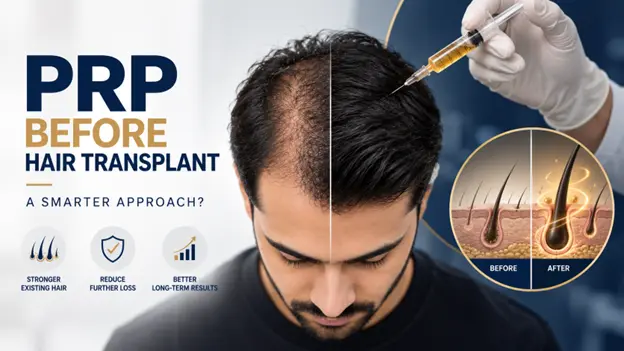
PRP, or Platelet-Rich Plasma, uses a concentrated portion of the patient's own blood containing platelets and growth factors. It is injected into areas of thinning hair with the aim of supporting existing follicles.
However, PRP is not compulsory before every hair transplant, and it cannot recreate follicles in a completely bald area. The decision should depend on your diagnosis, degree of miniaturization, existing hair, and overall transplant plan.
What Is PRP Hair Treatment?
PRP stands for Platelet-Rich Plasma.
During treatment:
Blood is collected → Centrifuged → Platelet-rich portion is separated → PRP is injected into the scalp
Platelets contain growth factors involved in tissue signaling and repair. In hair restoration, PRP hair treatment is primarily used to support existing viable hair follicles.
This distinction is important because PRP and hair transplantation have different jobs.
Why Consider PRP Before Hair Transplant Surgery?
A patient requiring a transplant may have two different types of areas:
1. Bald areas where significant follicular loss has already occurred.
2. Thinning areas where follicles are still present but becoming miniaturized.
Hair transplantation addresses the first problem by relocating follicles.
PRP may be considered for the second, and this is really where the benefits of PRP before hair transplant surgery become relevant.
Simple Treatment Strategy
| Hair Condition | Potential Approach |
| Healthy existing hair | Preserve and monitor |
| Miniaturized/thinning hair | Medical treatment ± PRP |
| Completely bald area | Hair transplant may be required |
| Progressive hair loss | Long-term stabilization strategy |
The goal should therefore not simply be to "do PRP before transplant." It should be to determine which follicles can still be preserved and which areas actually require transplantation.
1. PRP May Help Existing Thinning Hair
One of the main PRP therapy benefits is its potential to improve hair density and shaft thickness in appropriately selected patients with androgenetic alopecia.
This can be useful when a patient has significant miniaturized native hair around the proposed transplant area.
PRP does not create new follicles. Instead, the treatment is aimed at follicles that are still biologically present.
This means early intervention generally makes more sense than waiting until an area becomes completely bald.
It's worth setting expectations correctly here: PRP hair transplant results and PRP-alone results are not the same thing, and they shouldn't be compared directly. PRP works on existing follicles, while a transplant adds follicles that were never there before. Response to PRP also varies from person to person, which is why an honest assessment matters more than a fixed promise.
2. PRP May Help Reduce Ongoing Hair Loss
A hair transplant relocates donor follicles, but it does not automatically stop the patient's existing non-transplanted hair from continuing to thin.
This is an important concept.
Consider this scenario:
Transplanted Hair = Growing
but
Existing Native Hair = Continuing to Thin
Over time, this could create new gaps around the transplanted area.
For selected patients, PRP may form part of a broader strategy to manage ongoing thinning. Depending on the diagnosis, established medical therapies may also be recommended.
3. Stabilizing Hair Loss Can Improve Transplant Planning
A successful transplant isn't only about how the patient looks six months after surgery.
The surgeon also needs to think about:
- Future hair loss
- Remaining native hair
- Available donor grafts
- Future transplant requirements
- Long-term appearance
If hair loss is actively progressing, stabilizing or managing that progression before or alongside surgery can make long-term planning more predictable.
PRP may be one component of that strategy in appropriate patients.
4. PRP May Improve the Quality of Existing Hair
Patients sometimes interpret "density" purely as the number of follicles.
But the thickness of individual hairs also influences how dense the scalp appears.
If miniaturized hairs become stronger or thicker following successful treatment, the scalp may appear fuller even though new follicles have not been created.
This is one reason PRP hair treatment before hair transplant may be considered in patients who still have substantial existing hair.
Does PRP Help Hair Transplant Grafts Survive?
You may come across claims that PRP dramatically increases transplant graft survival.
This should be interpreted carefully.
PRP has biological properties that make it interesting in wound healing and hair restoration, and studies have investigated its use around hair transplantation. However, PRP preparation methods, platelet concentrations, treatment protocols, and study designs vary considerably.
Therefore, PRP should not be presented as a guarantee of improved graft survival.
Fundamental surgical factors remain extremely important:
- Gentle extraction
- Appropriate graft handling
- Proper graft storage
- Minimizing trauma
- Correct recipient-site creation
- Careful implantation
- Appropriate postoperative care
PRP cannot compensate for poor surgical technique.
PRP Therapy vs Hair Transplant: Which Is Better?
This is actually the wrong comparison because the treatments solve different problems.
| PRP Therapy | Hair Transplant |
| Works with existing follicles | Relocates follicles |
| Best for selected thinning areas | Best for suitable bald areas |
| Non-surgical | Surgical |
| Multiple sessions may be needed | Usually procedure-based |
| Results vary between patients | Can provide substantial restoration |
| Cannot create new follicles | Adds follicles to recipient area |
Therefore:
PRP = Preserve/strengthen suitable existing hair
Hair transplant = Restore hair where follicles have been lost
In some patients, using both as part of a comprehensive treatment plan makes more sense than choosing one against the other.
Can PRP Help You Avoid a Hair Transplant?
Sometimes, but not in the way advertisements may suggest.
If a person begins treatment while follicles are still present and miniaturizing, successful medical management may improve density enough that transplantation can be delayed or may not currently be necessary.
But once an area has become significantly bald with insufficient functioning follicles, PRP cannot simply regenerate a new population of hair follicles.
In short:
Thinning Area → Potential for medical/PRP treatment
Bald Area → Transplant may be necessary for meaningful restoration
Correct diagnosis determines which category you fall into.
Who May Benefit Most From PRP Before Hair Transplant?
PRP may be considered in patients with:
- Early-stage thinning
- Miniaturized existing follicles
- Diffuse thinning around the transplant area
- Ongoing androgenetic hair loss
- Significant native hair that should be preserved
It may provide considerably less benefit in:
- Completely bald areas
- Areas without viable follicles
- Advanced baldness where transplantation is the primary restorative option
Not everyone scheduled for a transplant automatically requires PRP.
PRP Before vs After Hair Transplant
PRP may be used at different stages, depending on the objective.
| PRP Before Transplant | PRP After Transplant |
| Focuses on existing thinning hair | May be used as an adjunct during recovery/ongoing hair management |
| May form part of stabilization strategy | Supports treatment of remaining native hair |
| Helps assess response of miniaturized hair | May be incorporated into long-term maintenance |
| Not compulsory | Not compulsory |
Individualize the protocol rather than selling every transplant patient a fixed PRP package.
How Many PRP Sessions Are Needed Before Hair Transplant?
There is no universal number that applies to everyone.
Protocols vary depending on:
- Diagnosis
- Degree of thinning
- Treatment goals
- Response
- PRP preparation method
- Other treatments being used
- Timing of planned transplantation
Some patients may undergo a series of sessions followed by maintenance, while others may not need PRP at all.
The treatment plan should therefore be based on clinical need rather than a standard package.
PRP Hair Treatment Before Hair Transplant in Surat: What Should You Look For?
Before selecting a hair transplant clinic in Surat, patients should focus on proper diagnosis, surgeon experience, treatment approach, and realistic expectations rather than choosing a procedure only based on promotional claims.
If you're considering PRP hair treatment before hair transplant in Surat, the first question should not be:
"How much does PRP cost?"
It should be:
"Do I actually need PRP?"
A proper assessment should determine:
- Your diagnosis
- Pattern and stage of hair loss
- Degree of miniaturization
- Donor-area quality
- Existing hair density
- Whether hair loss is progressing
- Which areas need preservation
- Which areas actually require transplantation
PRP should then be recommended only if it adds meaningful value to the overall treatment plan.
PRP Before Hair Transplant: Myths vs Facts
Myth: Everyone needs PRP before transplant.
Fact: No. It should be patient-specific.
Myth: PRP can regrow completely bald areas.
Fact: No. Viable follicles need to be present.
Myth: PRP can replace every hair transplant.
Fact: No. The treatments serve different purposes.
Myth: PRP guarantees graft survival.
Fact: No. Surgical technique remains critical.
Myth: One PRP session permanently stops hair loss.
Fact: No. Hair loss may require ongoing management.
Doctor's Take
The most important reason to use PRP before hair transplantation is not because the patient is undergoing surgery.
It is because the patient may still have miniaturized follicles worth preserving.
If the scalp is already completely bald in a particular area, repeatedly performing PRP there while expecting new follicles to appear can waste valuable time.
A better strategy is:
Diagnose → Identify viable follicles → Preserve existing hair → Restore genuinely bald areas → Plan for future hair loss
Final Thoughts
There are good reasons to choose PRP therapy before hair transplant surgery, but PRP should never become an automatic add-on for every patient.
The key question is whether you still have existing miniaturized follicles that may benefit from treatment.
PRP can potentially support those follicles and form part of a strategy for managing progressive hair loss. A hair transplant, on the other hand, relocates healthy donor follicles into areas where meaningful restoration is required.
So instead of asking "PRP or hair transplant?", the better question is:
Which areas should we preserve, which areas need transplantation, and how do we protect the overall result for the future?
That approach creates a more rational and long-term hair restoration plan.
A qualified hair specialist can assess whether PRP fits into your individual treatment plan or whether transplantation alone is the more suitable option. Choosing an experienced hair transplant clinic in Surat with proper diagnosis and personalized treatment planning can help you understand the right approach for your hair restoration goals. At RQC Hair Transplant Clinic, Surat, patients receive a detailed evaluation before any treatment is recommended.
