Recent Posts

How Female Pattern Hair Loss Differs from Male Hair Loss
Hair loss affects both men and women, but it does not always behave the same way.
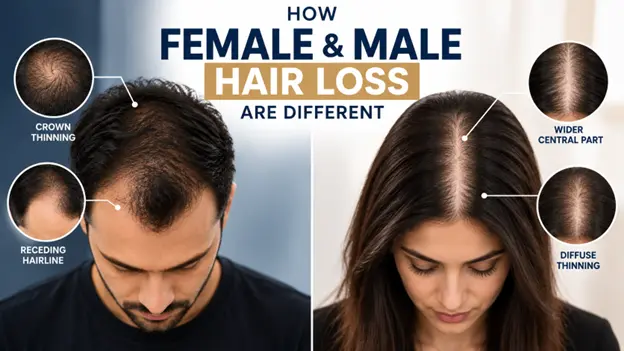
A man may first notice a receding hairline or thinning crown, while a woman may notice that her central part is becoming wider or her ponytail feels thinner.
Both may have androgenetic, or pattern, hair loss, but their clinical presentation, progression, evaluation, and treatment considerations can differ.
Understanding female pattern hair loss vs male pattern baldness is important because treating every type of hair fall in the same way can delay the correct diagnosis.
What Is Female Pattern Hair Loss?
Female pattern hair loss (FPHL) is a common form of progressive hair thinning in women.
Hair follicles gradually undergo miniaturization, meaning they begin producing finer, shorter hairs. Over time, this reduces visible density.
Women commonly notice:
- Widening of the central part
- Reduced density over the top of the scalp
- Increased scalp visibility
- A thinner ponytail
- Gradual reduction in hair volume
Unlike the typical male pattern, the frontal hairline is often relatively preserved.
What Is Male Pattern Hair Loss?
Male pattern hair loss (MPHL), also called androgenetic alopecia, is characterized by progressive miniaturization of genetically susceptible follicles.
The classic pattern includes:
- Temple recession
- Receding frontal hairline
- Crown thinning
- Progressive enlargement of bald areas
In advanced stages, the frontal and crown areas may eventually connect while hair around the sides and back remains relatively preserved.
Female vs Male Pattern Hair Loss: Key Differences
When people compare male vs female pattern hair loss symptoms side by side, a few consistent differences stand out.
| Feature | Female Pattern Hair Loss | Male Pattern Hair Loss |
| Common starting sign | Widening central part | Receding temples/hairline |
| Hairline | Often relatively preserved | Frequently recedes |
| Crown | Diffuse thinning | Defined crown thinning common |
| Completely bald areas | Less typical | Can occur in advanced stages |
| Pattern | Diffuse patterned thinning | Frontal + temporal + crown |
| Donor assessment | Particularly important | Usually more clearly defined |
| Progression | Often gradual thinning | Can progress to extensive baldness |
Both conditions involve follicular miniaturization, but the visible pattern can be quite different.
Why Does Female Hair Loss Look Different From Male Hair Loss?
Hormonal biology, genetics, follicular sensitivity, age, and other biological factors influence how pattern hair loss develops.
In men, dihydrotestosterone (DHT) plays an important role in androgenetic alopecia. Genetically susceptible follicles progressively miniaturize under androgen influence.
Androgens can also be relevant in women, but female pattern hair loss is more complex and does not necessarily mean a woman has abnormally high androgen levels.
This is why female hair loss should not simply be considered "male baldness in women."
What Does Female Pattern Hair Loss Look Like?
One of the earliest clues is often a widening central part.
The change usually shows up in stages:
Normal Part → Slightly Wider Part → Increased Scalp Visibility → Diffuse Reduction in Density
Another characteristic pattern can resemble a Christmas tree, where thinning becomes more noticeable toward the front of the central scalp.
The frontal hairline may remain relatively intact even while the hair behind it becomes considerably thinner.
Male Pattern Baldness Stages
Male-pattern hair loss is commonly described using the Norwood-Hamilton classification system.
Progression can broadly involve:
Mild temple recession
Deeper frontal recession
Crown thinning
Frontal and crown enlargement
Advanced baldness
Not every patient progresses through every stage or at the same speed.
The classification mainly helps doctors describe the pattern and plan long-term treatment.
Does Female Pattern Hair Loss Cause Bald Spots?
Usually, female pattern hair loss causes progressive thinning rather than isolated round bald patches.
If a woman develops clearly defined bald patches, other conditions should be considered, for example:
- Alopecia areata
- Traction alopecia
- Scarring alopecia
- Certain scalp diseases
This is why diagnosing hair loss from photographs or symptoms alone can sometimes be misleading.
Not Every Woman With Hair Fall Has Female Pattern Hair Loss
This is perhaps the most important point.
Women can experience increased shedding for many reasons unrelated to female pattern hair loss.
Other Causes of Female Hair Loss
| Condition | Typical Clue |
| Telogen effluvium | Sudden diffuse shedding |
| Iron deficiency | Diffuse hair loss with deficiency |
| Thyroid disorders | Diffuse thinning/shedding |
| Postpartum shedding | Begins after pregnancy |
| Alopecia areata | Distinct patches may occur |
| Traction alopecia | Loss in areas under repeated tension |
| Scalp disorders | Hair loss with inflammation/scaling |
| FPHL | Gradual patterned thinning |
Sometimes two conditions occur simultaneously.
For example, a woman with early female pattern hair loss may also develop telogen effluvium after illness, major stress, weight loss, or another trigger.
How Is Female Pattern Hair Loss Diagnosed?
Diagnosis begins with a detailed history and scalp examination.
A dermatologist may assess:
- Distribution of thinning
- Hairline
- Central part width
- Hair-shaft diameter variation
- Miniaturization
- Scalp condition
- Shedding history
- Family history
- Medication history
Trichoscopy can help visualize changes in the follicles and hair shaft.
Blood investigations may be appropriate when the history suggests nutritional, hormonal, thyroid, or other systemic contributors.
Not every patient requires exactly the same laboratory panel.
Female Pattern Hair Loss vs Male Pattern Hair Loss Treatment
The fundamental objective in both sexes is similar:
Preserve follicles → Reduce progression → Improve density where possible
However, treatment selection differs because sex, age, diagnosis, pregnancy potential, medical history, and hormonal factors matter. This is exactly why female pattern hair loss vs male pattern hair loss treatment plans are rarely interchangeable, even when the underlying diagnosis looks similar on paper.
Minoxidil
Topical minoxidil is one of the established treatment options for pattern hair loss.
It can help:
- Prolong the growth phase
- Improve miniaturized hair
- Increase apparent density in responders
Results require time, and ongoing treatment is generally necessary to maintain benefits.
Prescription Treatments
Other medications may be considered depending on the individual patient.
This is particularly important in women because some medications have pregnancy-related restrictions and contraindications.
Treatment should therefore be individualized rather than copying a male hair-loss regimen.
PRP Therapy
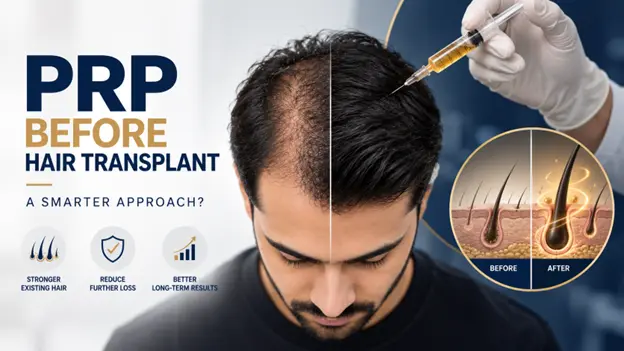
Platelet-Rich Plasma may be used as an adjunct treatment in selected patients with pattern thinning.
PRP aims to support existing follicles.
However, PRP does not create new follicles in completely bald areas.
It should form part of a diagnosis-based treatment strategy rather than automatically being prescribed to every patient with hair fall.
Can Women Have a Hair Transplant?
Yes, but patient selection is especially important.
Hair transplant for female pattern hair loss works on the same basic principle as it does in men: relocating follicles from a stable donor area to an area requiring restoration.
In many men, the permanent donor zone around the back and sides of the scalp is relatively well defined.
In some women, thinning can be more diffuse and may also involve potential donor regions.
Therefore, donor assessment is critical, and this is one of the biggest differences when comparing hair transplant for women vs men.
Who May Be a Good Female Hair Transplant Candidate?
Hair transplantation may be considered when a woman has:
- A sufficiently stable donor area
- Localized patterned thinning
- Hairline recession requiring restoration
- Traction-related loss in appropriate cases
- Stable areas of hair loss suitable for transplantation
- Realistic expectations
A woman with significant diffuse miniaturization throughout the donor area may not be an ideal transplant candidate.
Key Principle
Good recipient area + Poor donor area = Poor transplant strategy
A transplant cannot create unlimited new hair. It simply redistributes available follicles.
Why Early Diagnosis Matters
Hair transplantation should not always be the first step.
If follicles are still present but miniaturizing, early medical treatment may help preserve them.
Once follicles have been significantly lost, restoring density becomes more difficult.
This creates a simple treatment principle:
Early Thinning → Diagnose + Preserve
Progressive Miniaturization → Treat + Monitor
Established Suitable Hair Loss → Consider Restoration
Early diagnosis therefore protects not only current hair but also future treatment options.
Female Hair Loss: Myths vs Facts
Myth: Genetic hair loss only affects men.
Fact: False. Women can develop pattern hair loss.
Myth: Women with FPHL always become completely bald.
Fact: Usually false. The pattern often remains diffuse.
Myth: Every woman with shedding has FPHL.
Fact: False. Many other conditions cause shedding.
Myth: Female hair loss treatment is identical to male treatment.
Fact: False. Treatment requires individual assessment.
Myth: Every woman with thinning can have a transplant.
Fact: False. Donor quality is critical.
Myth: Cutting hair short stops hair loss.
Fact: False. Hair length does not stop follicular miniaturization.
Doctor's Take
The biggest mistake in treating female hair loss is using "hair fall" as the diagnosis.
Hair fall is a symptom.
A woman with a widening central part, a woman shedding heavily after pregnancy, and a woman developing round bald patches may all say:
"My hair is falling."
But they may have three completely different conditions requiring three different treatment strategies.
Diagnosis must come before treatment.
Final Thoughts
The major difference between female pattern hair loss and male pattern baldness is not simply that one occurs in women and the other in men.
Their patterns, progression, diagnostic considerations, treatment choices, and suitability for hair transplantation can differ significantly.
Men commonly develop frontal recession, temple loss, and crown thinning. Women more commonly develop central-part widening and diffuse reduction in density while retaining the frontal hairline.
Most importantly, not every case of female hair fall is female pattern hair loss.
If you notice a progressively widening part, increased scalp visibility, persistent shedding, or declining hair density, getting the correct diagnosis early is more valuable than immediately choosing a shampoo, supplement, PRP treatment, or hair transplant.
Because in hair loss treatment, the first question should never be:
"Which treatment should I take?"
It should be:
"What type of hair loss do I actually have?"
A dermatologist or hair restoration specialist can help answer that question with a proper scalp evaluation, rather than guesswork. At RQC Hair Transplant Clinic, Surat, a specialist clinic offering personalised hair restoration evaluation, this kind of assessment is available for both women and men before any treatment is suggested.
