Recent Posts

Why Does Hair Fall Increase During Summer Season?
Aug 25, 2026How Does PRP Therapy Stop Hair Loss Effectively?
July 15, 2026
Hair loss affects millions of men and women every year. While hair transplant surgery remains one of the most effective solutions for advanced baldness, many people begin searching for treatments long before they reach that stage.
One treatment that has gained tremendous popularity in recent years is PRP therapy for hair loss.
The good news is that PRP can be highly effective for the right candidate. However, understanding how it works—and who benefits most—is critical before investing time and money.
If you're searching for:
- PRP Therapy Stop Hair Loss
- PRP treatment for hair regrowth
- non-surgical hair loss solutions
- how does PRP work for hair
- best PRP hair treatment clinic
- PRP results for hair thinning
- cost of PRP therapy for hair
- stop hair fall naturally with PRP
This guide explains everything you need to know.
What Is PRP Therapy?
PRP stands for Platelet-Rich Plasma.
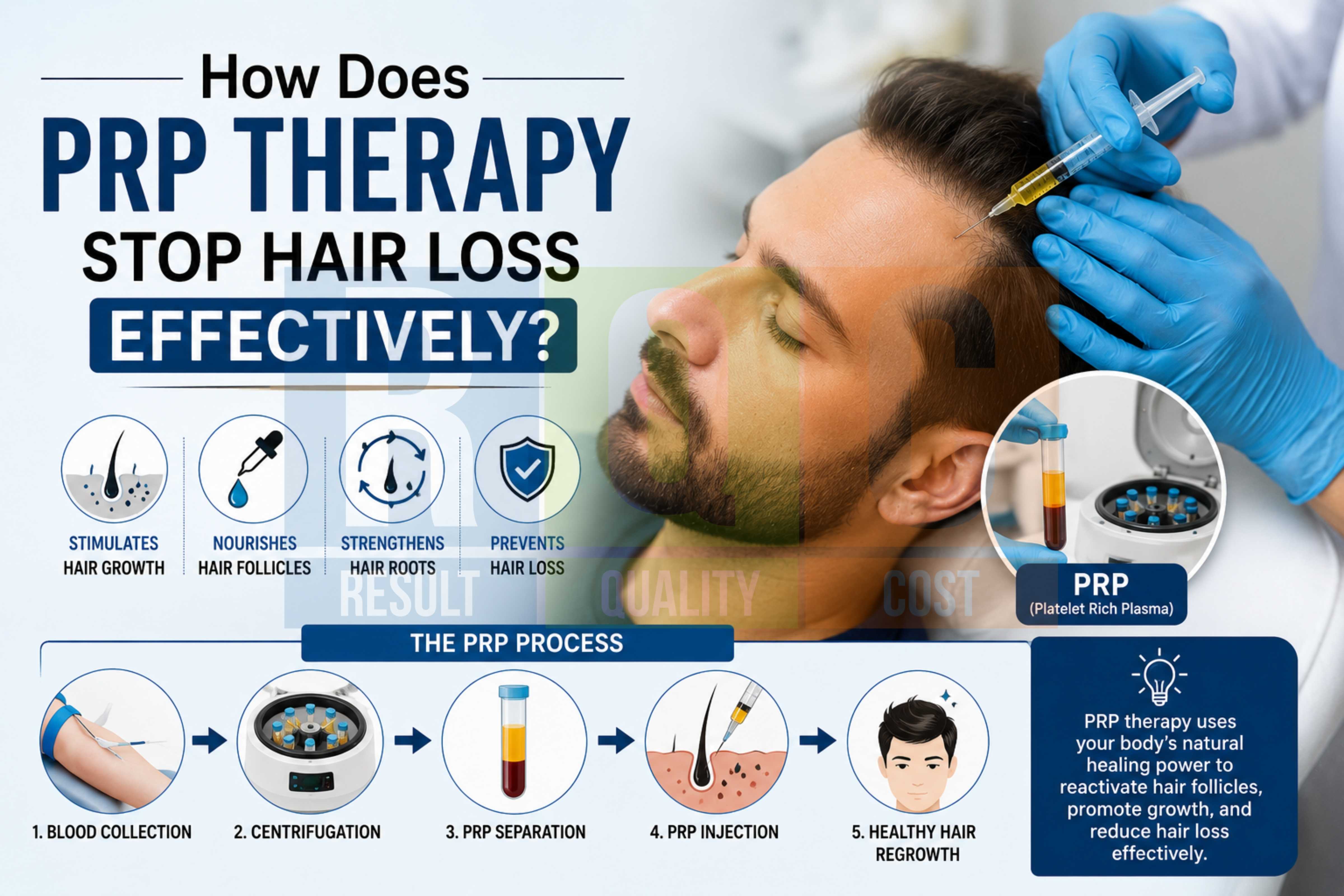
It is a regenerative treatment that uses your own blood to stimulate weakened hair follicles.
The procedure involves:
It is a regenerative treatment that uses your own blood to stimulate weakened hair follicles.
The procedure involves:
- Drawing a small blood sample
- Processing it in a centrifuge
- Concentrating platelets
- Injecting the platelet-rich plasma into the scalp
Why Platelets Matter for Hair Growth
Platelets are best known for helping blood clot after an injury.
However, they also contain powerful biological substances called growth factors.
These growth factors help:
✔ Tissue repair
✔ Blood vessel formation
✔ Cell regeneration
✔ Follicle stimulation
This is why PRP has become a popular treatment in both sports medicine and hair restoration.
However, they also contain powerful biological substances called growth factors.
These growth factors help:
✔ Tissue repair
✔ Blood vessel formation
✔ Cell regeneration
✔ Follicle stimulation
This is why PRP has become a popular treatment in both sports medicine and hair restoration.
How Does PRP Work for Hair?
To understand how PRP works for hair, think of weakened follicles as plants receiving less water and nutrients.
PRP helps improve the environment around those follicles.
PRP Mechanism of Action
Blood Sample
↓
Platelet Separation
↓
Growth Factor Concentration
↓
Scalp Injection
↓
Follicle Stimulation
↓
Improved Hair Growth
The goal is not to create brand-new follicles.
Instead, PRP helps strengthen follicles that are still alive but becoming weaker.
PRP helps improve the environment around those follicles.
PRP Mechanism of Action
Blood Sample
↓
Platelet Separation
↓
Growth Factor Concentration
↓
Scalp Injection
↓
Follicle Stimulation
↓
Improved Hair Growth
The goal is not to create brand-new follicles.
Instead, PRP helps strengthen follicles that are still alive but becoming weaker.
Can PRP Therapy Stop Hair Loss?
Yes, in many cases PRP therapy can help slow or reduce ongoing hair loss.
However, PRP works best when:
However, PRP works best when:
- Follicles are still active
- Hair loss is in the early stages
- Significant baldness has not yet developed
Who Benefits Most from PRP?
Not everyone responds equally.
Best Candidates for PRP Treatment
PRP is often most successful before significant follicle loss occurs.
Best Candidates for PRP Treatment
| Condition | Expected Response |
| Early thinning | Excellent |
| Diffuse hair loss | Very good |
| Male pattern hair loss (early) | Good |
| Female pattern thinning | Good |
| Completely bald areas | Poor |
PRP Results for Hair Thinning
One reason PRP has become popular is that results are gradual and natural.
Instead of creating an artificial change, it works with existing follicles.
Instead of creating an artificial change, it works with existing follicles.
PRP Results Timeline
| Timeline | Expected Change |
| Month 1 | Reduced shedding |
| Month 2–3 | Improved texture |
| Month 3–4 | Early thickening |
| Month 6 | Visible density improvement |
| Month 9–12 | Maximum benefits |
What Improvements Can Patients Expect?
Patients commonly report:
- Reduced daily hair fall
- Improved hair thickness
- Better hair quality
- Increased density
- Stronger hair shafts
PRP Therapy vs Other Non-Surgical Hair Loss Solutions
Comparison Table
PRP often works best when combined with a broader treatment strategy.
| Treatment | Surgical? | Best For |
| PRP | No | Early thinning |
| Medication | No | Ongoing hair loss |
| Low-Level Laser Therapy | No | Supportive treatment |
| Hair Transplant | Yes | Advanced hair loss |
Can PRP Replace a Hair Transplant?
This is one of the biggest misconceptions.
PRP Cannot:
✘ Create new follicles
✘ Restore completely bald areas
✘ Replace hair transplant in advanced baldness
PRP Can:
✔ Strengthen existing follicles
✔ Slow progression
✔ Improve thickness
✔ Delay future hair loss
PRP Cannot:
✘ Create new follicles
✘ Restore completely bald areas
✘ Replace hair transplant in advanced baldness
PRP Can:
✔ Strengthen existing follicles
✔ Slow progression
✔ Improve thickness
✔ Delay future hair loss
Can You Stop Hair Fall Naturally with PRP?
Many people ask if they can stop hair fall naturally with PRP.
The answer depends on how you define "natural."
PRP uses:
The answer depends on how you define "natural."
PRP uses:
- Your own blood
- Your own growth factors
- No foreign substances
Cost of PRP Therapy for Hair
One of the most common questions patients ask is:
What is the cost of PRP therapy for hair?
Pricing varies depending on:
What is the cost of PRP therapy for hair?
Pricing varies depending on:
- Number of sessions
- Clinic expertise
- Equipment used
- Treatment protocol
Typical Cost Range
| Treatment Plan | Approximate Range |
| Single Session | ₹3,000–₹10,000 |
| Package Plan | ₹12,000–₹40,000 |
How Many PRP Sessions Are Needed?
Most patients require multiple sessions.
Typical Protocol
Hair restoration is usually a long-term process.
Typical Protocol
| Phase | Frequency |
| Initial Phase | Every 3–4 weeks |
| Maintenance Phase | Every 4–6 months |
Myths vs Facts About PRP
| Myth | Fact |
| PRP regrows hair in bald areas | It works best where follicles still exist |
| One session is enough | Multiple sessions are usually needed |
| Results are instant | Growth takes several months |
| PRP works for everyone | Results vary depending on follicle health |
Doctor's Take
PRP is one of the most valuable tools for early-stage hair loss because it allows intervention before follicles become permanently inactive. The earlier treatment begins, the better the potential outcome.
Final Thoughts
PRP can be an effective tool for slowing hair loss and improving hair quality, especially when treatment begins before extensive follicle loss has occurred. However, it is not a cure for genetic hair loss, and its effectiveness varies from person to person. For many individuals, the best outcomes come from combining PRP with evidence-based treatments such as minoxidil or, where appropriate and prescribed by a physician, finasteride.
If your hair loss is primarily thinning, PRP may help preserve and strengthen existing hair. If you already have large bald areas where follicles are no longer active, PRP alone is unlikely to restore significant coverage, and other options such as a hair transplant may be needed.
If your hair loss is primarily thinning, PRP may help preserve and strengthen existing hair. If you already have large bald areas where follicles are no longer active, PRP alone is unlikely to restore significant coverage, and other options such as a hair transplant may be needed.
