Recent Posts
Is Hot Water Secretly Damaging Your Hair and Scalp Today?
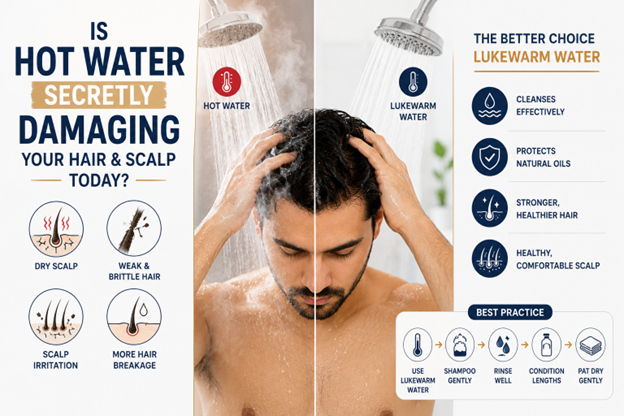
A hot shower can feel relaxing, especially after a long day or during winter. But if your hair feels dry, rough, frizzy, or your scalp becomes itchy after washing, you may wonder whether hot water is contributing to the problem.
The answer is more nuanced than many social-media claims suggest.
Very hot water can worsen dryness of the scalp and hair shaft and may indirectly increase breakage. However, normal hot-water exposure is not considered a direct cause of permanent hair loss or follicle destruction.
So, instead of switching from extremely hot water to cold water, the better approach is to understand the best water temperature for hair washing and how temperature affects your scalp and hair.
What Does Very Hot Water Do to Your Hair?
Your scalp naturally produces sebum, which contributes to the protective lipid environment of the skin and hair.
Frequent exposure to very hot water can remove surface oils and worsen dryness, particularly in people who already have dry or chemically treated hair.
The process can be understood simply:
Very Hot Water → Increased Dryness → Rough Hair → More Friction & Tangling → Increased Breakage
Hot water can therefore affect the quality of the hair shaft, even though it doesn't simply destroy the hair root.
Heat also causes the small blood vessels near the skin's surface to widen temporarily. On the scalp, this can make an already sensitive or irritated scalp feel warmer and more reactive right after a very hot shower.
Hot Water vs Cold Water for Hair Wash
One of the most common questions is whether cold water is healthier for hair.
In reality, you don't need either extreme.
| Factor | Very Hot Water | Lukewarm Water | Cold Water |
| Cleansing | Effective | Effective | Effective with proper shampooing |
| Dryness risk | Higher | Lower | Low |
| Scalp comfort | May irritate | Usually comfortable | May be uncomfortable |
| Good for damaged hair | Less suitable | Preferred | Not necessary |
| Winter practicality | Comfortable but potentially drying | Best balance | Often uncomfortable |
| Routine recommendation | Avoid excessive heat | Recommended | Optional |
Comfortably lukewarm water that feels warm but not hot is generally suitable for most people.
Does Hot Water Cause Hair Fall?
Not in the way it is commonly portrayed online.
Understanding hot water hair fall causes starts with recognising that "hair fall" is not one single thing. There are three different problems people often call "hair fall":
1. Hair shedding
The entire hair separates as part of its growth cycle.
2. Hair breakage
The shaft snaps somewhere along its length.
3. Progressive hair loss
The follicle gradually produces thinner hair, as occurs in androgenetic alopecia or pattern baldness.
Very hot water may worsen dryness and make already fragile hair more susceptible to breakage.
That is different from causing male or female pattern baldness.
Does Hot Water Weaken Hair Roots?
A common myth is that hot water "opens the pores," loosens the roots, and causes hairs to fall out.
This oversimplifies how hair follicles work.
The hair follicle sits within the skin. An ordinary hot shower does not simply open the follicle and release a healthy, growing hair.
Therefore, if you're developing a receding hairline, thinning crown, widening central partition, or progressive loss of density, changing your shower temperature alone is unlikely to solve the underlying problem.
How Hot Water Damages Hair Follicles: Does It Really?
The keyword "how hot water damages hair follicles" is commonly searched, but scientifically the more relevant concern is hair-shaft and scalp-barrier damage, rather than direct follicular destruction.
Normal shower temperatures are very different from a true thermal burn.
Extremely high temperatures capable of burning the skin can obviously cause tissue injury. But that's not what happens during an ordinary warm shower.
For everyday hair care, focus on avoiding excessive heat that leaves the scalp uncomfortable, red, or excessively dry.
Effect of Hot Water on Scalp Dry Skin
Your scalp is skin, and its barrier can become dry and irritated.
Repeated exposure to very hot water may worsen:
- Dryness
- Tightness
- Itching
- Flaking
- Scalp sensitivity
People with eczema-prone or sensitive skin may notice these effects more readily.
However, persistent flakes should not automatically be diagnosed as "dry scalp." Dandruff and seborrheic dermatitis can also cause scaling and require a different treatment approach, often involving medicated shampoos rather than simply moisturising.
Who Should Be More Careful with Hot Water?
Some hair types are more vulnerable to excessive washing temperatures.
Extra caution may help if you have:
- Bleached hair
- Chemically coloured hair
- Dry or frizzy hair
- Curly hair
- Heat-damaged hair
- Sensitive scalp
- Eczema-prone skin
- Already fragile hair shafts
For these individuals, combining very hot showers with frequent shampooing, chemical processing, and heat styling may further increase dryness and breakage.
What Is the Best Water Temperature for Hair Washing?
You don't need a thermometer in your bathroom.
A simple rule works:
Use comfortably lukewarm water that cleans your scalp without making it feel hot, irritated, or red.
The water should feel pleasant rather than intensely hot.
Cold water is not necessary for healthy hair growth, and extremely hot water provides no special cleansing benefit worth damaging your scalp comfort.
Should I Wash Hair With Cold Water in Winter?
No. You do not need to suffer through freezing showers for healthier hair.
Lukewarm water is perfectly reasonable during winter.
Cold water is sometimes claimed to "seal the cuticle" or dramatically increase shine. Hair-shaft behavior is more complicated than the popular idea of opening and closing the cuticle like a door.
Conditioning and reducing chemical, mechanical, and heat damage are generally more useful strategies for improving hair quality.
How to Fix Dry Scalp From Hot Showers
If you've been taking very hot showers and your scalp has become dry or uncomfortable, start by changing the routine rather than buying multiple products.
Try this simple approach:
1. Reduce water temperature
Switch from very hot to lukewarm.
2. Shorten prolonged hot showers
Long exposure can increase dryness.
3. Use an appropriate shampoo
Your shampoo should match your scalp condition and washing frequency.
4. Condition the hair lengths
This can reduce friction and improve manageability.
5. Reduce additional heat exposure
Frequent blow-drying and straightening can compound hair-shaft dryness.
If itching, redness, or flaking continues despite these changes, consider having the scalp evaluated.
A Better Hair-Washing Routine
A simple routine is usually enough:
Lukewarm Water
↓
Wet Hair Thoroughly
↓
Apply Shampoo Mainly to the Scalp
↓
Massage Gently, Don't Scratch
↓
Rinse Properly
↓
Condition Hair Lengths if Needed
↓
Gently Pat Dry
Avoid aggressively rubbing wet hair with a towel, particularly if your hair is long, bleached, or already fragile.
If Hot Water Isn't Causing Baldness, What Is?
This is perhaps the most important section of this article.
If you're experiencing persistent or progressive hair loss, don't spend months changing your shower temperature while ignoring the actual cause.
Common causes can include:
| Hair Problem | Possible Cause |
| Receding temples | Male pattern hair loss |
| Crown thinning | Androgenetic alopecia |
| Widening central part | Female pattern hair loss |
| Sudden diffuse shedding | Telogen effluvium |
| Round bald patches | Alopecia areata |
| Hair fall with nutritional issue | Iron or nutritional deficiency may contribute |
| Hair loss with scalp inflammation | Scalp disorder |
| Excessive breakage | Chemical, heat, or mechanical damage |
The appropriate treatment depends on the diagnosis. If hair loss continues despite improving your hair care routine, a professional evaluation can help identify whether the cause is pattern hair loss, scalp conditions, or another underlying issue.
Hair Fall During Washing Doesn't Always Mean the Water Caused It
People often become alarmed because they notice more hair in the shower.
But washing frequently reveals hairs that were already in the shedding phase and had become loosely retained among other hairs.
This is particularly noticeable in people with longer hair or those who wash less frequently.
Seeing hairs during washing, therefore, doesn't prove that the water temperature caused those hairs to shed.
Hot Water and Hair: Myths vs Facts
Myth: Hot water directly causes baldness.
Fact: Generally false.
Myth: Very hot water can worsen dryness.
Fact: True.
Myth: Hot water can contribute to breakage indirectly.
Fact: Possible.
Myth: Cold water is essential for hair growth.
Fact: False.
Myth: Lukewarm water is suitable for routine washing.
Fact: Yes.
Myth: Changing water temperature can reverse pattern baldness.
Fact: No.
Final Thoughts
So, is hot water secretly damaging your hair?
If the water is excessively hot and used frequently, it can contribute to dryness, scalp irritation, roughness, and hair breakage. But ordinary hot-water exposure should not be blamed as a major direct cause of permanent follicular hair loss.
For most people, the solution is simple:
Avoid extremes, use lukewarm water, shampoo gently, condition appropriately, and minimize additional heat and chemical damage.
And if your hairline is receding, your crown is becoming visible, your central part is widening, or shedding continues for weeks or months, don't assume changing the shower temperature will fix it.
Persistent hair loss deserves a proper diagnosis so the actual cause can be identified and treated early. At RQC Hair Transplant Clinic, Surat, patients can receive a detailed hair and scalp evaluation to understand the actual cause of hair concerns and explore suitable treatment options.
