Recent Posts
Why Does Hair Fall Increase During Summer Season?
Aug 25, 2026How Hair Color Damages Hair Quality and Texture
July 25, 2026
How does hair color damage hair quality and texture?
The answer lies in the chemistry of hair coloring. While modern hair dyes are safer than ever before, they still alter the structure of the hair shaft. Understanding how this process works can help you make better decisions and protect your hair from unnecessary damage.
If you're searching for:
If you're searching for:
- How Hair Color Damages Hair Quality
- hair coloring disadvantages
- chemical hair dye side effects
- fix rough hair texture after dye
- how to repair damaged hair quality
- hair thinning due to hair color
- avoid hair damage from bleaching
- dry and frizzy hair solutions
Understanding Hair Structure
Before understanding how coloring affects hair, it's important to understand what hair is made of.
The cuticle acts as a protective shield.
Healthy hair has:
The cuticle acts as a protective shield.
Healthy hair has:
- Smooth cuticles
- Good moisture retention
- Natural shine
- Strong elasticity
What Happens During Hair Coloring?
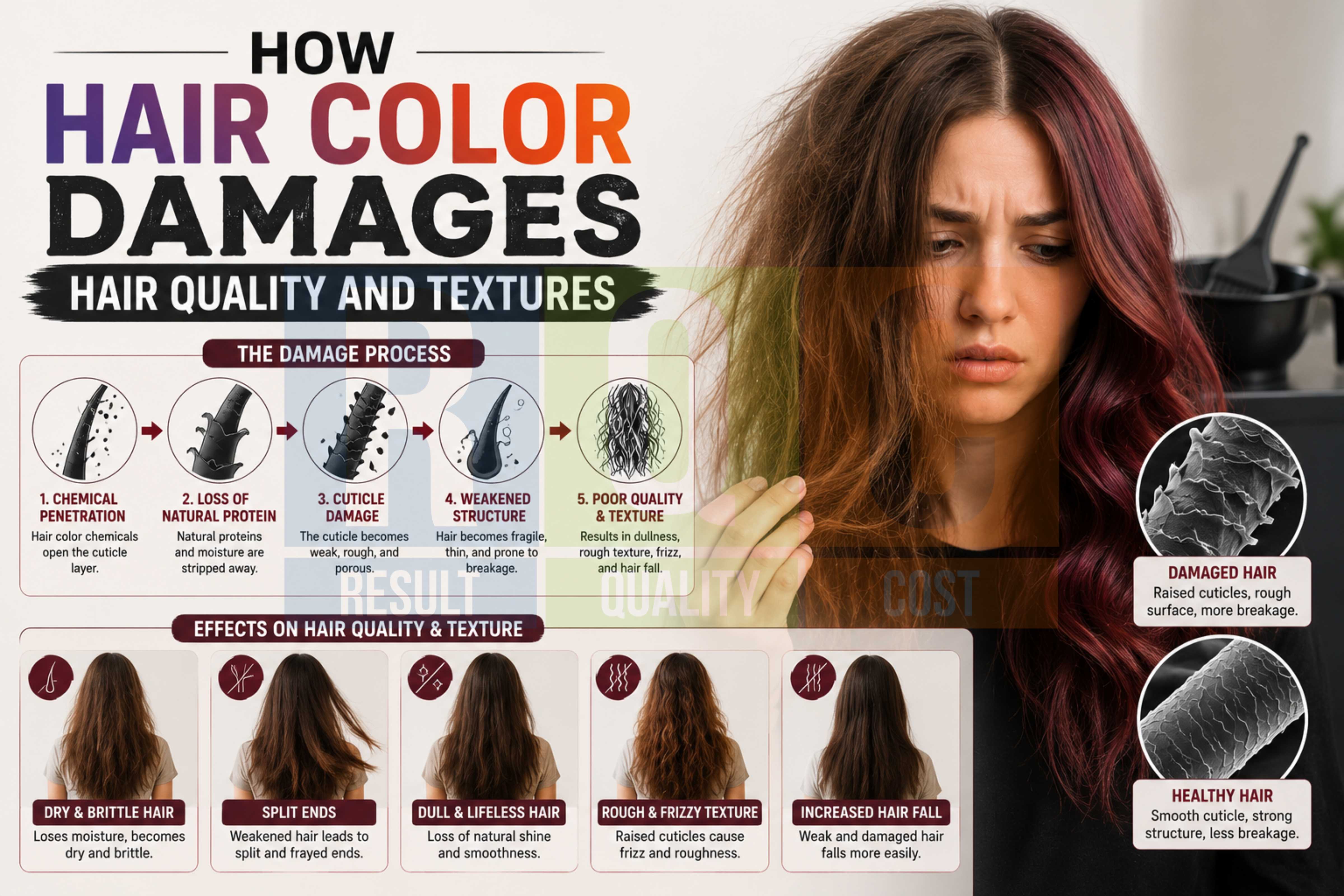
Permanent hair coloring works by opening the protective cuticle layer.
The dye then enters the cortex where natural pigment is altered or replaced.
Hair Coloring Process
Healthy Hair
↓
Cuticle Opens
↓
Pigment Removed
↓
New Color Deposited
↓
Cuticle Closes (Partially)
↓
Potential Hair Damage
Every coloring session creates some degree of structural stress.
The dye then enters the cortex where natural pigment is altered or replaced.
Hair Coloring Process
Healthy Hair
↓
Cuticle Opens
↓
Pigment Removed
↓
New Color Deposited
↓
Cuticle Closes (Partially)
↓
Potential Hair Damage
Every coloring session creates some degree of structural stress.
How Hair Color Damages Hair Quality
Many people assume hair color only changes appearance.
In reality, it also affects the physical properties of hair.
1. Loss of Moisture
Opening the cuticle allows moisture to escape more easily.
This can lead to:
2. Protein Loss
Hair is primarily made of keratin protein.
Repeated coloring may gradually weaken these protein structures.
Consequences
Porosity refers to how easily hair absorbs and loses moisture.
Color-treated hair often becomes more porous.
Signs of High Porosity
✔ Frizz
✔ Dryness
✔ Tangling
✔ Dull appearance
4. Cuticle Damage
Repeated chemical exposure can prevent the cuticle from fully closing.
This creates:
In reality, it also affects the physical properties of hair.
1. Loss of Moisture
Opening the cuticle allows moisture to escape more easily.
This can lead to:
- Dryness
- Rough texture
- Reduced softness
2. Protein Loss
Hair is primarily made of keratin protein.
Repeated coloring may gradually weaken these protein structures.
Consequences
- Reduced strength
- Increased breakage
- Difficulty styling
Porosity refers to how easily hair absorbs and loses moisture.
Color-treated hair often becomes more porous.
Signs of High Porosity
✔ Frizz
✔ Dryness
✔ Tangling
✔ Dull appearance
4. Cuticle Damage
Repeated chemical exposure can prevent the cuticle from fully closing.
This creates:
- Rough texture
- Reduced shine
- Increased vulnerability.
Hair Coloring Disadvantages
Hair coloring offers cosmetic benefits but also comes with limitations.
Hair Coloring Disadvantages Table
Not everyone experiences severe damage, but risk increases with frequency.
Hair Coloring Disadvantages Table
| Short-Term Effects | Long-Term Effects |
| Dryness | Increased breakage |
| Rough texture | Weakened hair shaft |
| Temporary irritation | Chronic damage |
| Frizz | Reduced shine |
| Tangling | Hair fragility |
Chemical Hair Dye Side Effects
Hair dyes contain ingredients designed to penetrate the hair shaft.
While generally safe when used correctly, some individuals experience side effects.
Common Chemical Hair Dye Side Effects
While generally safe when used correctly, some individuals experience side effects.
Common Chemical Hair Dye Side Effects
- Scalp irritation
- Dryness
- Increased sensitivity
- Allergic reactions
- Hair shaft damage
Does Hair Color Cause Hair Loss?
This is one of the most common myths.
The Truth
Hair dye does not usually destroy hair follicles.
However, excessive chemical processing may lead to:
The Truth
Hair dye does not usually destroy hair follicles.
However, excessive chemical processing may lead to:
- Hair breakage
- Hair shaft weakening
- Appearance of thinning
Hair Thinning Due to Hair Color
When people notice thinner hair after coloring, the cause is often breakage rather than actual follicle loss.
Difference Between Hair Loss and Breakage
Understanding this distinction is important when choosing treatment.
Difference Between Hair Loss and Breakage
| Hair Loss | Hair Breakage |
| Follicle affected | Hair shaft affected |
| Root comes out | Hair snaps midway |
| Medical condition possible | Chemical damage common |
Why Bleaching Causes More Damage
Among all chemical treatments, bleaching is usually the most aggressive.
Bleaching works by removing natural pigment from the hair shaft.
This process requires stronger chemical reactions than standard coloring.
Bleaching works by removing natural pigment from the hair shaft.
This process requires stronger chemical reactions than standard coloring.
Hair Damage Risk Scale
| Treatment | Damage Risk |
| Semi-permanent color | Low |
| Permanent color | Moderate |
| Highlights | Moderate |
| Repeated coloring | Moderate-High |
| Bleaching | High |
| Multiple bleaching sessions | Very High |
How to Avoid Hair Damage from Bleaching
If bleaching is necessary, damage can be minimized.
Recommendations
Recommendations
- Space sessions appropriately
- Use professional application
- Avoid overlapping bleach
- Deep condition regularly
- Reduce heat styling
Fix Rough Hair Texture After Dye
Many people notice that hair feels rough immediately after coloring.
Fortunately, texture can often be improved.
Step 1: Moisture Restoration
Use:
Protein treatments can strengthen weakened hair shafts.
Look for products containing:
Fortunately, texture can often be improved.
Step 1: Moisture Restoration
Use:
- Hydrating masks
- Leave-in conditioners
- Deep conditioning treatments
Protein treatments can strengthen weakened hair shafts.
Look for products containing:
- Keratinc
- Amino acids
- Hydrolyzed proteins
Weekly Recovery Plan for Colored Hair
Fix Rough Hair Texture After Dye
Consistency is more important than using expensive products.
| Day | Action |
| Monday | Hydrating mask |
| Wednesday | Leave-in treatment |
| Friday | Protein treatment |
| Weekend | Deep conditioning |
How to Repair Damaged Hair Quality
Hair Recovery Framework
Damaged Hair
↓
Hydration
↓
Protein Repair
↓
Cuticle Protection
↓
Improved Texture
Essential Recovery Habits
Damaged Hair
↓
Hydration
↓
Protein Repair
↓
Cuticle Protection
↓
Improved Texture
Essential Recovery Habits
- Gentle shampoo
- Conditioner after every wash
- Heat protection
- Adequate nutrition
- Regular trims
Dry and Frizzy Hair Solutions
Frizz usually occurs when damaged hair struggles to retain moisture.
Dry and Frizzy Hair Solutions
Dry and Frizzy Hair Solutions
| Problem | Solution |
| Dryness | Moisture masks |
| Frizz | Leave-in conditioner |
| Rough texture | Protein treatment |
| Dullness | Cuticle-sealing serum |
| Breakage | Heat reduction |
Myth vs Fact
| Myth | Fact |
| Hair dye permanently kills follicles | Usually false |
| Bleaching and coloring are equally damaging | Bleaching is generally harsher |
| Damaged hair can fully heal itself | Hair shafts cannot self-repair |
| Expensive products instantly reverse damage | Consistent care matters more |
Final Thoughts
Understanding how hair color damages hair quality and texture can help you make smarter decisions about coloring and aftercare.
Hair coloring can be a great way to refresh your appearance and express your personal style, but it is important to understand its effects on hair health. The chemicals used in coloring treatments can weaken the hair structure, reduce moisture levels, and alter the natural texture over time.
While occasional coloring may cause minimal damage, frequent treatments especially bleaching can lead to dryness, breakage, frizz, and loss of shine. By following a proper hair care routine, using nourishing products, and giving your hair time to recover between coloring sessions, you can maintain healthier, stronger hair while still enjoying the benefits of beautiful color.
Hair coloring can be a great way to refresh your appearance and express your personal style, but it is important to understand its effects on hair health. The chemicals used in coloring treatments can weaken the hair structure, reduce moisture levels, and alter the natural texture over time.
While occasional coloring may cause minimal damage, frequent treatments especially bleaching can lead to dryness, breakage, frizz, and loss of shine. By following a proper hair care routine, using nourishing products, and giving your hair time to recover between coloring sessions, you can maintain healthier, stronger hair while still enjoying the benefits of beautiful color.
