Recent Posts

PRP vs Hair Transplant: Which is Best for Women?
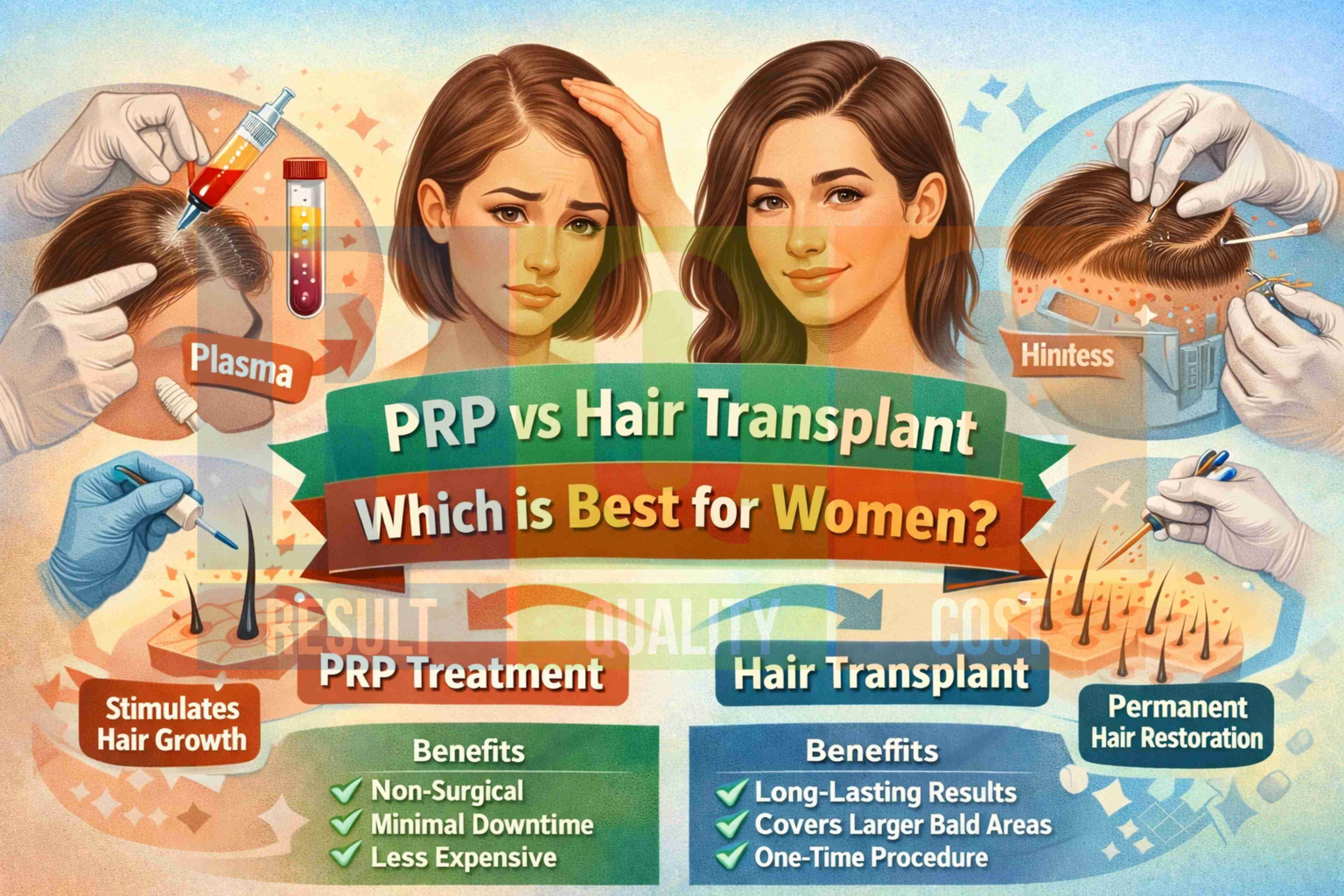
Hair loss in women is often more complex and emotionally challenging than in men. Unlike male pattern baldness, which usually follows a predictable receding hairline, women typically experience diffuse thinning across the entire scalp. This makes the decision-making process much more sensitive. A common question many women ask today is: PRP vs Hair Transplant for Women which one is truly better?.
At Rqchairtransplant, we believe that education is the first step toward restoration. If you are searching for the best hair treatment for women or a reliable female pattern baldness solution, this comprehensive guide will give you the medical clarity you need to make the right choice for your hair health.
Understanding the Unique Nature of Female Hair Loss
Before choosing between PRP vs Hair Transplant, it is vital to understand how hair loss works in the female body. Women rarely develop a completely bald patch. Instead, the thinning occurs globally, often leading to a wider part line and a general loss of volume.
Common Signs in Women:
• Diffuse thinning on the top and crown areas.
• The appearance of the "Christmas tree" pattern on the center part.
• Significant reduction in the thickness of hair when tied in a ponytail.
• Increased scalp visibility under bright indoor lighting.
According to Dr. Vivek Galani, these symptoms are often the result of hormonal shifts, nutritional deficiencies, or genetic predispositions. Because women have different aesthetic goals and hair density needs, the treatment plan must be highly personalized at clinics like Rqc Hair Transplant.
What Is PRP Treatment for Women?
PRP treatment for women is a non-surgical, regenerative procedure that utilizes your own blood cells to stimulate inactive hair follicles. Platelet Rich Plasma is packed with growth factors that jump-start the repair process in your scalp.
The Scientific Process:
1. A small sample of the patient's blood is collected.
2. The blood is spun in a specialized centrifuge to isolate the platelets.
3. The concentrated growth factors are injected directly into the areas of the scalp where thinning is most visible.
This method improves blood circulation and strengthens the diameter of existing hair strands. It is a powerful female pattern baldness solution for those who are in the early stages of thinning and want to avoid any surgical intervention.
What Is Hair Transplant for Women?
A hair transplant is a permanent surgical procedure where healthy hair follicles are moved from a donor area (the back or sides of the head) to the thinning zones. While many believe this is only for men, advanced techniques like FUE and DPI have made it a viable option for women as well.
Key Characteristics for Women:
• It offers a permanent and one-time solution for localized thinning.
• It requires a healthy donor area which can sometimes be a challenge in diffuse thinning.
• The results are natural looking and blend with your original hair.
PRP vs Hair Transplant: A Detailed Comparison
The debate of PRP vs Hair Transplant for Women often comes down to the current stage of your hair loss. If you have active but weak follicles, PRP is the hero. If you have lost hair completely in certain areas, a transplant is the answer.
| Parameter | PRP Treatment | Hair Transplant |
| Procedure Type | Non-surgical and minimally invasive | Surgical hair restoration |
| Best Application | Early thinning and hair fall control | Advanced thinning or receding hairlines |
| Recovery Period | Zero downtime, return to work immediately | 7 to 10 days for initial healing |
| Visible Results | Gradual improvement in 3 to 6 months | Full results visible in 8 to 12 months |
| Long-term Maintenance | Requires sessions every 6 to 12 months | Permanent results with minimal care |
For many patients, the choice of PRP vs transplant for thinning hair is not an "either-or" decision. Dr. Vivek Galani often recommends combining both to ensure the transplanted hair has the best environment to grow.
When PRP Is the Best Hair Treatment for Women
PRP is often considered the gold standard for early intervention. It is the ideal choice for women who are dealing with:
• Post-pregnancy hair shedding caused by hormonal drops.
• Early stages of diffuse thinning across the crown.
• Stress-related hair fall that has not yet reached advanced stages.
• Thinning where the scalp is still mostly covered by miniaturized hair.
The PRP treatment for women at Rqc Hair Transplant is designed to provide visible volume without any downtime, making it perfect for busy professionals.
When Hair Transplant Is the Better Option
While non-surgical paths are popular, a hair transplant is the superior choice when the hair follicles have reached a point of no return. It is recommended for:
• Correcting a high forehead or receding temples.
• Restoring density in areas where the scalp is clearly visible despite medical therapy.
• Women who have stable hair loss patterns and a strong donor area.
The female hair transplant results at our clinic are designed to be undetectable, ensuring that you can style your hair in any direction with complete confidence.
The Hybrid Approach: Combining Treatments for Maximum Density
In 2026, the modern approach to hair restoration is integration. Dr. Vivek Galani frequently uses PRP as a supportive therapy before and after a surgical transplant. This "Combined Therapy" helps in:
1. Boosting the survival rate of the newly implanted hair grafts.
2. Accelerating the healing process of the scalp after surgery.
3. Strengthening the "native" hair that was not part of the transplant.
This ensures that the female hair transplant results are not just good, but exceptional and long lasting.
Myths and Realities Women Should Know
• Myth:
PRP is a magic cure for total baldness. (Reality: It only works on active, living follicles.)
• Myth:
Women have to shave their heads for a transplant. (Reality: At Rqchairtransplant, we use "No-Shave" techniques for female patients.)
• Myth:
Hair transplants look artificial on women. (Reality: When performed by experts, the results are completely natural and blend with your hair texture.)
Why Expert Consultation Is Non-Negotiable
Choosing between PRP vs Hair Transplant based on internet searches can be risky. Women's hair loss is often linked to underlying medical issues like iron deficiency or thyroid problems. At Rqchairtransplant, every patient undergoes a thorough scalp analysis. Dr. Vivek Galani ensures that we address the root cause before suggesting a surgical or non-surgical route.
Final Conclusion
Whether you choose PRP vs Hair Transplant for Women, the most important factor is the timing. If you act while your hair is just beginning to thin, PRP treatment for women can save your natural look for years. If the loss is more advanced, a transplant offers the only permanent female pattern baldness solution.
Trust the experts at Rqc Hair Transplant to guide you toward the best hair treatment for women and help you regain the volume and confidence you deserve.
