Recent Posts

Why Does Hair Fall Increase During Summer Season?
Aug 25, 2026Why Modern Hair Transplant Surgery Gives Natural Results
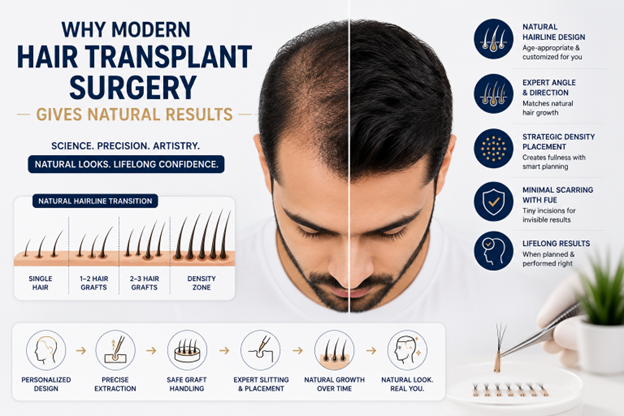
Hair transplantation has changed dramatically over the past few decades.
Older procedures sometimes produced obvious rows, plug-like grafts, unnatural hairlines, or visible donor scars. These results created the misconception that a hair transplant will always be noticeable.
Modern hair restoration is very different.
Today, modern hair transplant techniques allow surgeons to work with individual follicular units and carefully control the hairline, density, angle, direction, and distribution of transplanted hair.
However, the technique alone does not create a natural result. A successful transplant requires a combination of surgical precision, artistic planning, donor management, and understanding how natural hair actually grows.
So, why does modern hair transplant surgery give natural results, and what should you look for before choosing a procedure?
What Makes a Hair Transplant Look Natural?
A natural-looking transplant should not immediately make someone think, "He has had a hair transplant."
Instead, the result should blend with the patient's facial features, age, existing hair, and expected future hair-loss pattern.
The major factors are:
- Natural hairline design
- Correct selection of grafts
- Proper angle and direction
- Strategic density
- Appropriate donor management
- Careful graft handling
- Planning for future hair loss
Naturalness comes from a combination:
Hairline + Graft Selection + Angle + Direction + Density + Donor Planning = Natural Result
Why Older Hair Transplants Sometimes Looked Artificial
Earlier hair restoration techniques often involved transplanting larger groups of follicles or "plugs."
This could create a doll-like appearance because naturally growing hair does not emerge from the scalp in large, evenly spaced clusters.
Modern transplantation works with naturally occurring follicular units, which commonly contain one or more hairs.
This allows surgeons to recreate the natural distribution of scalp hair far more precisely.
| Older Approach | Modern Approach |
| Larger plugs | Individual follicular units |
| Obvious rows | Irregular natural distribution |
| Straight hairline | Micro-irregular hairline |
| Limited angle control | Precise direction and angle |
| Artificial density pattern | Graduated density |
| More obvious appearance | Better blending |
1. Natural Hairline Design Makes the Biggest Difference
The hairline is usually the first thing people notice.
A technically successful transplant can still look unnatural if the hairline is poorly designed.
A natural hairline design in hair transplant surgery considers:
- Facial proportions
- Forehead dimensions
- Age
- Existing hairline
- Degree of baldness
- Future hair-loss progression
- Donor capacity
One common mistake is creating an excessively low hairline in a young patient.
It may initially appear attractive, but as the patient ages and existing hair continues to thin, the result may become unnatural and consume too many valuable donor grafts.
A good hairline therefore needs to look appropriate today and 10-20 years later.
2. A Natural Hairline Shouldn't Be Perfectly Straight
Look closely at a natural hairline and you'll notice that it is not a perfectly straight geometric line.
There are tiny irregularities and variations.
Modern hairline design recreates these subtle irregularities rather than drawing an artificial straight border across the forehead.
But irregularity must also be controlled.
A random zigzag hairline is no more natural than a perfectly straight one.
The objective is organized irregularity that resembles natural growth.
3. Single-Hair Grafts Are Important at the Front
This is one of the most important technical details in natural hair transplantation.
Naturally, the leading edge of the frontal hairline tends to appear finer and softer.
Therefore, surgeons generally use single-hair follicular units toward the front.
Larger follicular units can then be strategically positioned farther behind to create density.
Natural Density Transition
Front of Hairline
Single hairs → Single hairs → 2-hair grafts → 2/3-hair grafts → Density zone
Placing thick multi-hair grafts directly along the front can create a harsh, pluggy appearance.
4. Angle and Direction Matter as Much as Density
Hair does not grow vertically from every part of the scalp.
Different regions have different growth patterns.
For example:
- Frontal hair tends to emerge at an acute angle.
- Temporal hair follows a specific backward/downward direction.
- Crown hair often forms a spiral or whorl.
If transplanted hairs are placed at incorrect angles, the patient may have excellent graft survival but still get an unnatural result.
This is why "number of grafts" is not enough.
A successful transplant is not simply:
How many grafts can we implant?
It is:
Where should each graft go, and at what angle and direction?
This is also where the technique used for creating the recipient site matters. At RQC Hair Transplant Clinic, this step is called slitting, where angle, depth, and direction are planned for every single site using Sapphire FUE technology, a technique Dr. Vivek Galani trained in during a visit to Turkey in March 2020, where he was awarded by Dr. Tayfun Oguzhoglu and became one of the first surgeons to bring it to India.
5. Dense Hair Graft Placement Requires Strategy
Patients understandably want maximum density.
But dense hair graft placement does not mean simply packing as many grafts as possible into every square centimetre.
The surgeon must consider:
- Available donor supply
- Recipient area
- Existing native hair
- Hair calibre
- Number of hairs per follicular unit
- Hair-to-scalp colour contrast
- Future baldness
- Blood supply and tissue characteristics
Strategic placement can create the visual perception of density without unnecessarily consuming donor follicles.
This is especially important because donor hair is limited.
6. Why FUE Can Produce a Natural Look
In an FUE hair transplant, follicular units are individually extracted from the donor area rather than removing a strip of scalp.
This allows careful selection and redistribution of follicular units.
Benefits can include:
- No linear strip scar
- Individual follicular-unit harvesting
- Greater flexibility in graft selection
- Faster donor-area recovery in many patients
- Ability to wear shorter hairstyles in appropriate cases
However, there is an important point:
FUE does not automatically guarantee a natural result.
FUE primarily describes how grafts are harvested.
Naturalness depends heavily on what happens afterward: hairline planning, recipient-site creation, graft selection, direction, density, and implantation.
An FUE hair transplant natural look also depends on how the grafts are handled during implantation. RQC follows a "No Root Touch" method while placing grafts back into the scalp, so the root of each follicle is not damaged during handling, which supports better survival and growth.
Other techniques you may come across, such as DHI (Direct Hair Implantation), use a specialised pen-like tool to place grafts directly into the scalp without pre-made incisions. Like FUE, DHI is still only a harvesting or placement method. The surgeon's hairline design, angle control, and density planning remain what actually determine the natural look, regardless of which technique is used.
Does Modern FUE Leave No Scar?
You may see advertisements describing FUE as a "scarless hair transplant."
Technically, this is misleading.
Any procedure that removes tissue creates some degree of healing response.
FUE generally creates many tiny distributed extraction scars rather than the linear donor scar associated with FUT.
When extraction is properly planned and the donor area heals well, these tiny marks can be difficult to notice.
But the correct terminology is minimal or less conspicuous scarring, not "zero scar."
This is really why modern hair transplant does not leave scars in the way people fear: not because tissue removal leaves no mark at all, but because thousands of tiny, well-spaced extraction points heal far less visibly than a single long incision.
7. Donor Management Is Part of a Natural Result
The recipient area gets most of the attention, but the donor area is equally important.
Overharvesting can create:
Patchy donor density
Visible scalp
Uneven appearance
Reduced graft availability for future procedures
A good surgeon therefore doesn't ask only:
"How many grafts can I extract today?"
The better question is:
"How many grafts can I safely use while preserving the donor area for the patient's lifetime?"
This becomes especially important in younger patients with progressive male pattern baldness.
Can People Notice a Hair Transplant?
During the initial healing period, yes. Redness, crusting, short transplanted hairs, or temporary changes may make the procedure noticeable.
But once a well-planned transplant has matured, the objective is that someone sees your hair, not your surgery.
A transplant becomes more noticeable when there is:
- An excessively straight hairline
- Hairline positioned too low
- Thick grafts at the leading edge
- Incorrect angles
- Poor density distribution
- Visible donor overharvesting
- Insufficient planning for progressive hair loss
This is why evaluating real, consistent before-and-after results is important when selecting a surgeon.
Advanced post-operative technique also affects how noticeable the early healing phase is. At RQC Hair Transplant Clinic, the incidence of swelling has been kept below 1 percent through the use of advanced techniques during the procedure, which shortens how long the healing phase draws attention to itself.
How Long Does a Hair Transplant Take to Look Natural?
Hair transplant results develop gradually.
| Time After Transplant | What You May See |
| 0-2 weeks | Healing, redness and crusting |
| 2-8 weeks | Transplanted hair commonly sheds |
| 3-4 months | Early new growth |
| 5-6 months | Visible improvement |
| 9-12 months | Significant maturation |
| 12-18 months | Further maturation, especially in some areas |
The exact hair transplant results timeline varies between individuals and scalp regions.
The crown, for example, may mature more slowly than the frontal area.
What Determines the Final Result?
Instead of focusing only on FUE, DHI, Sapphire, or any other marketing term, patients should evaluate the entire transplantation process.
The 7 Factors Behind a Natural Hair Transplant
| Factor | Why It Matters |
| Diagnosis | Determines whether transplant is appropriate |
| Donor planning | Protects limited graft supply |
| Hairline design | Creates age-appropriate appearance |
| Graft selection | Produces soft transitions |
| Angle & direction | Recreates natural growth |
| Density planning | Creates visual fullness |
| Surgical execution | Influences graft survival and healing |
No single machine or technique can replace these fundamentals.
How to Get a Natural-Looking Hairline After Surgery
Before choosing your procedure, ask the clinic:
Who designs the hairline?
Hairline planning should involve the surgeon.
How is future hair loss considered?
The design should account for progressive baldness.
How are single-hair grafts selected?
They are particularly valuable at the leading edge.
How is donor density assessed?
Donor preservation should be part of the plan.
Can I see comparable before-and-after cases?
Look for patients with similar baldness patterns, hair calibre, and donor characteristics.
A clinic promising the maximum possible number of grafts or an extremely low hairline is not necessarily offering the best result.
Modern Hair Transplant: Myth vs Fact
| Myth | Fact |
| Every hair transplant looks obvious | Modern procedures can look highly natural |
| More grafts always mean a better result | Strategic placement matters more |
| FUE is completely scarless | FUE produces tiny distributed scars |
| A perfectly straight hairline looks best | Natural hairlines contain subtle irregularities |
| Technique determines everything | Surgeon planning and execution are critical |
| Results are final within 3 months | Full maturation commonly takes much longer |
Final Thoughts
The reason modern hair transplant surgery gives natural results is not simply because technology has improved.
Modern FUE provides surgeons with better tools, but the final result still depends on planning and execution.
The most natural transplants combine:
Good donor management + Age-appropriate hairline + Correct graft selection + Natural angle and direction + Strategic density
If you're considering a hair transplant, don't judge a clinic only by the technique it advertises or the number of grafts it promises.
Evaluate the surgeon's hairline designs, donor management philosophy, comparable before-and-after results, and long-term treatment planning.
Because ultimately, the best hair transplant isn't the one with the most grafts.
It's the one that doesn't look like a hair transplant.
At RQC Hair Transplant Clinic in Surat, Dr. Vivek Galani plans each hairline personally and uses Sapphire FUE with a No Root Touch implantation approach, so the focus stays on natural design and not just graft count.
