Recent Posts
What to Check Before Booking a PRP Therapy Session
Nov 15, 2026
What to Check Before Booking a PRP Therapy Session
PRP therapy for hair loss has become a popular non-surgical option for people dealing with hair thinning. It may help selected patients, but before you book a PRP package, there is one question that matters more than the price or the number of sessions:
Is PRP actually the right treatment for your type of hair loss?
Before booking a PRP therapy session, check these three things first:
Your hair loss has been properly diagnosed. Different causes of hair loss may require different treatments.
You are a suitable candidate for PRP. The condition of your existing hair follicles and your medical history matter.
The clinic has a clear treatment and follow-up plan. You should know what results are realistic, how your progress will be measured, and what the treatment will cost.
PRP stands for Platelet-Rich Plasma. It is a preparation made from your own blood and injected into selected areas of the scalp. Research suggests that PRP may improve hair density in some patients with androgenetic alopecia, also known as pattern hair loss. However, results vary, and the available evidence has limitations. PRP cannot create new follicles in an area that is completely bald, and it is not the right treatment for every cause of hair fall.
This guide covers the important checks, along with the questions worth asking before you commit to a package.
Quick Answer
Before booking PRP treatment for hair loss, check three things: your hair loss has been properly diagnosed, you still have viable follicles that PRP may help, and the clinic has a clear plan to measure whether the treatment is working. Be cautious about any clinic that guarantees regrowth or sells the same package to every patient.
First: Understand What PRP Hair Treatment Actually Does
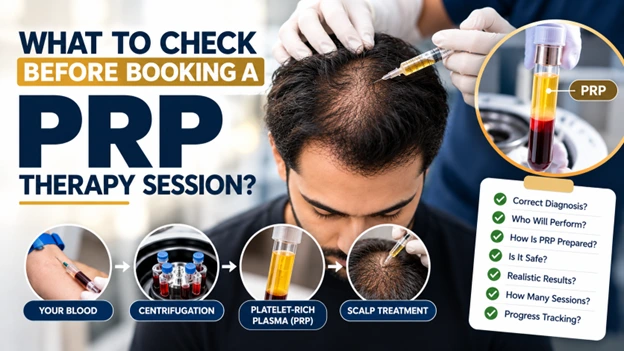
PRP stands for Platelet-Rich Plasma. The treatment begins with collecting a small sample of your blood, which is then processed to prepare platelet-rich plasma.
The basic process is:
Blood Collection → Centrifugation → Platelet-Rich Plasma Preparation → Scalp Treatment
Platelets contain growth factors and other substances involved in tissue repair and cell signalling. In hair restoration, PRP is used with the aim of supporting hair growth in suitable patients.
The key word is existing. PRP does not transplant hair follicles. It may help selected patients who still have viable follicles, but it cannot be relied upon to create new follicles in completely bald areas.
PRP is also not suitable for every cause of hair loss. Before booking, ask your doctor whether it is appropriate for your condition and what improvement you can realistically expect.
What Happens During a PRP Therapy Session?
Knowing what a session involves helps you judge whether a clinic is explaining things properly. The usual steps are:
1. Consultation, where your scalp and hair loss are assessed.
2. A numbing cream is applied to the area being treated.
3. A small amount of your blood is drawn.
4. The blood is processed to prepare the PRP.
5. The PRP is injected into the scalp near the hair roots.
6. You receive aftercare instructions and a follow-up plan.
At RQC Hair Transplant & Skin Clinic, a PRP session takes about 60 to 90 minutes. The consultation comes first, and that is the right time to get your questions answered before any blood is drawn.
1. Has Your Hair Loss Been Diagnosed First?
Before paying for PRP, make sure you understand what is causing your hair loss.
Hair fall is a symptom, not a diagnosis. Different conditions can cause shedding or thinning, and each may need a different treatment approach.
Hair loss may result from:
- Male or female pattern hair loss
- Telogen effluvium
- Alopecia areata
- Nutritional deficiencies
- Thyroid disorders
- Scalp conditions
- Medication-related hair shedding
- Traction or mechanical damage
For example, someone with androgenetic alopecia may be considered for PRP as part of a broader treatment plan. Someone who is shedding because of an underlying medical condition may need that cause investigated and treated first.
The correct order is:
Hair Loss → Medical Assessment → Diagnosis → Treatment Plan → Decide Whether PRP Is Appropriate
Not:
Hair Loss → Buy PRP Package
A dermatologist or appropriately qualified doctor can assess your scalp, medical history, pattern of hair loss, and whether further tests are needed. The American Academy of Dermatology's guidance on hair loss diagnosis and treatment also explains why finding the cause comes first.
2. Who Is Recommending and Supervising Your PRP?
PRP for hair loss involves blood collection and injections into the scalp. It should be treated as a medical procedure rather than a cosmetic salon service.
Before booking, ask the clinic:
- Who will evaluate my hair loss?
- Who will decide whether PRP is appropriate for me?
- Who will perform or supervise the procedure?
- What qualifications and relevant experience does that person have?
- Who will review my progress after treatment?
- What happens if I do not respond to PRP?
A proper medical assessment helps decide whether PRP is suitable or whether another treatment would be better. The clinic should also explain the procedure, possible risks, expected benefits, limitations, and follow-up arrangements before you make a decision.
3. How Is the PRP Prepared?
Not every PRP treatment uses exactly the same preparation method.
PRP protocols can differ in:
- Amount of blood collected
- Centrifugation method
- Platelet concentration
- Preparation equipment
- Number of processing steps
- Final volume prepared
- Whether other components are added
These differences matter because the preparation method can influence the final product. This variation is also one reason research findings and results differ between studies.
Before booking, ask: How is the PRP prepared? What protocol does the clinic follow? Why is this approach suitable for my treatment plan?
You do not need to understand every technical detail, but the clinic should be able to explain its process clearly.
Be cautious if a clinic makes impressive claims about its method but cannot explain what those claims mean.
4. Is Proper Sterility Maintained?
PRP involves blood collection and injections into the scalp, so sterile technique is essential.
Look for:
- A clean clinical environment
- Sterile needles and syringes
- Appropriate blood collection and handling
- Safe disposal of used needles and medical sharps
- Trained clinical staff
- Proper handling of equipment used during the procedure
You can ask how the clinic prevents contamination during blood collection, PRP preparation, and injection.
Choosing a clinic only because it advertises the cheapest price ignores an important part of treatment quality: how safely the procedure is performed.
5. What PRP Treatment Results Can You Realistically Expect?
Be cautious if anyone promises that PRP will definitely regrow all your hair.
PRP results vary between patients and depend on factors such as:
- The cause of hair loss
- The severity and duration of thinning
- The condition of existing follicles
- How quickly the hair loss is progressing
- Other treatments being used
- Individual biological response
- The preparation and treatment protocol
A 2024 systematic review and meta-analysis of randomised trials, published in Anais Brasileiros de Dermatologia, found that PRP appeared to increase hair density in androgenetic alopecia. The authors also noted that the studies were highly heterogeneous, of low quality, and affected by publication bias, and they called for more high-quality trials.
Hair grows slowly, so PRP treatment results are judged over months, not days. RQC's PRP page describes this typical pattern for patients who follow the treatment consistently:
- 1 to 3 months: Early improvement in hair quality, less shedding, and early signs of new growth.
- 3 to 6 months: Noticeable thickening of existing hair and better volume and density.
- 6 to 12 months: Continued growth, with maximum results usually seen within this period.
These are general expectations, not guarantees. Your own response depends on your diagnosis and the condition of your follicles.
Before booking, ask the doctor to explain:
- What improvement may be possible in my case?
- What limitations should I understand?
- When will my progress be assessed?
- Are other treatments also appropriate?
- What happens if PRP does not give the expected improvement?
A responsible clinic discusses realistic expectations instead of guaranteeing a particular result.
6. How Many PRP Sessions Do You Actually Need?
There is no single PRP schedule that applies to every patient. Some plans involve an initial series of sessions followed by reassessment or maintenance, and the right plan depends on your condition, the protocol being used, and how you respond.
For example, RQC's PRP page recommends a minimum of 6 sessions, about 30 days apart, for visible results, and notes that maintenance treatment every 6 to 12 months is typically recommended to sustain them. Other clinics may suggest a different plan. Whatever number a clinic suggests, you should be able to ask why.
Before purchasing a package, ask: Why are you recommending this number of sessions for me?
The answer should relate to your diagnosis and treatment plan, not just to the clinic's standard package. You should also ask:
- How often will the sessions take place?
- When will my progress be reviewed?
- Will the plan change if I do not respond?
- Are maintenance sessions recommended, and why?
- What is included in the total package price?
More sessions do not automatically mean better results. The number should be explained as part of an individual treatment plan.
7. How Will Your PRP Results Be Measured?
This is one of the most overlooked questions. Hair changes slowly, and without proper documentation it is hard to tell whether the treatment has worked.
A good programme may include:
- Standardised photographs before treatment
- Consistent lighting and camera angles
- Scalp examination
- Trichoscopy when appropriate
- Clinical assessment of hair density and miniaturisation
- Regular follow-up appointments
Treatment without tracking creates guesswork. The process should look like this:
Baseline Assessment → Treatment → Follow-Up → Comparison → Review the Treatment Plan
Avoid relying only on casual photographs, short-term impressions, or promotional before-and-after pictures.
What Side Effects Should You Ask About?
PRP uses your own blood, so the risk of an allergic reaction is generally considered low, but side effects can still happen. RQC's PRP page lists these as the common, usually temporary ones:
- Mild pain or discomfort during the injections
- Redness and swelling
- Soreness at the injection site
- Itching or scalp sensitivity
Rare risks include infection, bruising, and allergic reaction. Ask the clinic what to expect, how to care for your scalp afterwards, and who to contact if something seems wrong. Tell your doctor about your medical history and any medicines you take before the procedure.
Who Is More Likely to Benefit From PRP for Hair Thinning?
PRP may be considered for selected patients who still have existing follicles that could respond to treatment.
Potential candidates may include some people with:
- Early pattern hair loss
- Miniaturised hair
- Mild-to-moderate thinning
- Reduced hair density
- Existing hair that may benefit from a broader treatment strategy
These examples do not guarantee that PRP will work for a particular person. A doctor should assess the cause of hair loss, scalp condition, medical history, and your goals before recommending it.
In some cases, PRP may be used alongside established hair fall treatment when clinically appropriate. It should not automatically replace other treatments that may suit your condition better. Many patients also ask about PRP hair restoration after a transplant. It can help in selected cases, but it is not mandatory after every hair transplant.
When PRP May Not Be the Right Solution
PRP should not automatically be recommended to everyone who is losing hair. There are situations where another treatment, or more medical assessment, may be the better choice.
The Area Is Completely Bald
PRP does not transplant follicles. Where viable follicles are absent, it cannot be relied upon to create new ones.
A doctor can assess whether other options, including hair transplantation in suitable patients, may be appropriate.
The Cause of Hair Loss Has Not Been Diagnosed
Sudden or widespread shedding may need medical investigation before treatment begins. Starting PRP without knowing the cause may delay the right care.
There Is an Active Scalp Condition
Scalp inflammation, infection, or another skin condition may need assessment and treatment before a procedure is considered. Tell your doctor about any scalp symptoms before booking.
You Expect a Hair-Transplant-Level Transformation
PRP and hair transplantation solve different problems, as the comparison below shows.
PRP vs Hair Transplant: What Is the Difference?
| PRP Therapy | Hair Transplant |
| Uses platelet-rich plasma prepared from your own blood | Surgically relocates hair follicles from a donor area |
| Does not transplant new follicles | Moves existing follicles to a recipient area |
| May help selected patients with existing follicles | May restore hair in suitable areas when donor hair is available |
| May involve multiple sessions, depending on the plan | Involves surgery and postoperative recovery |
| Results vary and are not guaranteed | Results depend on patient suitability, donor supply, surgical planning, and healing |
Questions to Ask Before Booking PRP
Before paying for your first PRP session, ask the clinic:
- What type of hair loss do I have?
- Why do you think PRP may help me?
- Are my existing follicles suitable for this treatment?
- Are other treatments more appropriate or also needed?
- Who will perform or supervise the procedure?
- How is the PRP prepared?
- What hygiene and safety procedures are followed?
- Why are you recommending this number of sessions?
- How will my progress be measured?
- What results are realistic in my case?
- What happens if I do not respond to treatment?
- What is included in the total cost?
The clinic should answer these clearly and explain any uncertainties. If important questions stay unanswered, consider a second medical opinion before buying a package.
Red Flags Before Booking PRP Therapy
Be cautious if a clinic offers:
- Claims of 100% guaranteed hair regrowth
- The same package for every patient, without an assessment
- Treatment without a medical evaluation
- No scalp examination or progress-tracking plan
- No baseline photographs
- Promises to regrow hair in every completely bald area
- PRP presented as a cure for every type of hair loss
- No discussion of other suitable treatments
- Pressure to buy multiple sessions immediately
- Unclear information about who performs the procedure
- No explanation of preparation methods or safety practices
PRP should be recommended because there is a clinical reason to use it, not because it is easy to sell as a package.
PRP Treatment Cost: What Should You Compare Before Choosing?
Price matters, but it should not be the first or only factor. Two clinics offering “one PRP session” may use different preparation methods, treatment protocols, supervision arrangements, and follow-up.
When comparing PRP hair treatment clinics, look at:
| What to Compare | Why It Matters |
| Medical diagnosis | Helps decide whether PRP is appropriate for your condition |
| Medical supervision | Supports sound assessment and treatment decisions |
| PRP preparation protocol | Preparation methods can differ |
| Sterility and hygiene | Important for blood handling and injections |
| Documentation | Helps set a baseline and assess changes |
| Follow-up | Allows the clinic to review your response |
| Treatment plan | Explains the proposed number and timing of sessions |
| Cost transparency | Shows what is included and what may cost extra |
Before booking, ask for a clear breakdown of the total PRP treatment cost. Confirm whether the quoted price includes the consultation, every session, follow-up appointments, and any additional services.
The cheapest PRP session has little value if PRP was never the right treatment for you. The priority is a suitable plan with proper medical assessment and realistic expectations.
PRP Therapy: Myth vs Fact
| Myth | Fact |
| PRP creates new hair follicles. | No. PRP does not transplant or create a new population of follicles. |
| Everyone with hair fall needs PRP. | Suitability depends on the cause of hair loss and an individual assessment. |
| More sessions always mean better results. | The number and timing of sessions should come from an individual treatment plan. |
| One preparation method is perfect for everyone. | Preparation methods vary, and no single protocol has been shown to be ideal for every patient. |
| PRP replaces every hair-loss medication. | No. A doctor should decide which treatments suit you, alone or together. |
| PRP can never help. | Research suggests potential benefit for some patients with pattern hair loss, but results vary and the evidence has limitations. |
Doctor's Take
Before booking PRP, do not start with the question:
“How many sessions do I need?”
Start with:
“What is causing my hair loss?”
Once the diagnosis is clear, the next question is whether your existing follicles are likely to benefit from PRP, and whether other treatments should be used alongside it or instead of it.
Research suggests that PRP may help selected patients with pattern hair loss, but the evidence has limitations and protocols vary. PRP is a treatment tool, not a diagnosis and not a universal solution. A good decision rests on medical assessment, realistic expectations, and a clear plan to review progress.
Final Thoughts
Before booking a PRP therapy session for hair loss, check three things above everything else:
1. Do I have the correct diagnosis?
2. Is PRP appropriate for the condition of my existing follicles?
3. Is there a clear plan to measure whether the treatment is working?
You should also understand who will supervise the procedure, how the PRP is prepared, what the total cost includes, and which alternatives are available. A good clinic explains why PRP is being recommended specifically for you, what improvement is realistic, and what the next step is if the treatment does not help.
The best decision is not booking the largest PRP package. It is choosing the right treatment for the right type of hair loss.
If you are considering PRP for hair loss, RQC Hair Transplant & Skin Clinic in Surat offers a free hair assessment through an online form, and a 1-to-1 video consultation with Dr. Vivek Galani (consultation fee ₹799), so you can discuss whether PRP suits your hair loss before committing to any package.
