Recent Posts
What to Check Before Booking a PRP Therapy Session
Nov 15, 2026
Signs Your Hair Transplant Shouldn't Wait for Correction
A hair transplant takes time to mature. During the first few months, temporary shedding, uneven growth, redness, or low density can all be part of normal recovery.
So, seeing an imperfect result at three or four months does not automatically mean your hair transplant has failed.
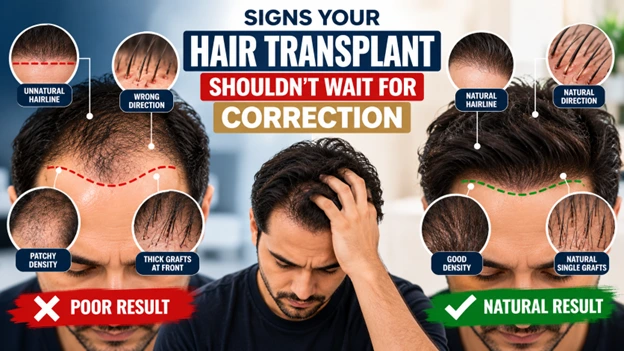
However, some problems, such as an unnatural hairline, incorrect graft direction, poor mature density, or donor overharvesting, may require expert assessment.
The key is knowing the difference between:
A transplant that is still developing
and
A transplant that may genuinely need correction.
Quick Answer
Most early changes, such as shedding, redness, uneven growth, and low density at three or four months, are part of normal healing. The signs that shouldn't wait for hair transplant correction fall into two groups:
- Needs prompt medical attention: persistent or significant pain, discharge, increasing redness, unusual scalp lesions, or signs of infection.
- Needs expert assessment once the result has matured: an unnatural hairline, wrong graft direction, persistent poor density, visible thick grafts at the front, donor overharvesting, significant scarring, or poor planning for future hair loss.
Judging the cosmetic result too early is the most common mistake. A hair transplant correction plan is usually more accurate after the original result has had enough time to mature.
First: Has Enough Time Passed to Judge Your Hair Transplant?
Before calling a transplant unsuccessful, consider its growth timeline. Here is a general hair transplant results timeline:
- 0 to 2 weeks: healing, redness, and crusting
- 2 to 8 weeks: transplanted hairs may shed
- 3 to 4 months: early new growth begins
- 4 to 6 months: density gradually improves
- 6 to 9 months: more noticeable cosmetic improvement
- 9 to 12 months: the result becomes easier to assess
- 12 to 18 months: further maturation may occur
Growth rates vary between patients, and the crown may mature more slowly than the frontal area.
Therefore, poor density at four months is very different from poor density after adequate maturation.
What Is Considered a Bad or Failed Hair Transplant?
A failed hair transplant doesn't always mean that none of the grafts grew.
A transplant can have good graft growth and still produce a poor cosmetic result.
Problems may include:
- Poor graft survival
- Unnatural hairline
- Incorrect angles
- Inappropriate graft distribution
- Low or patchy density
- Donor overharvesting
- Visible scarring
- Poor planning for future hair loss
Fixing these problems is called hair transplant correction, or failed hair transplant repair. It therefore begins by identifying what actually went wrong.
7 Signs Your Hair Transplant May Need Correction
1. Your Hairline Looks Unnatural
The hairline is one of the most visually important parts of a transplant.
Warning signs include:
A perfectly straight hairline
A hairline positioned too low
A harsh or pluggy appearance
Poorly designed temples
Obvious asymmetry
An unnatural density transition
A natural hairline should contain subtle irregularities and blend gradually into the denser hair behind it.
Correction may involve:
Redesign → Camouflage → Add appropriate grafts → Selective removal in suitable cases
The exact approach depends on the original design and the remaining donor supply.
2. Hair Grows in the Wrong Direction
Natural hair doesn't grow vertically from every part of the scalp.
Frontal hair generally emerges at relatively acute angles, temporal hair follows characteristic directions, and the crown commonly forms a whorl.
If recipient sites were created at inappropriate angles, transplanted hair may:
- Stick upward
- Cross neighboring hairs
- Grow against the natural direction
- Become difficult to style
This can make a transplant noticeable even when graft survival is good.
Correcting poorly angled grafts can be more complicated than simply adding density.
3. Your Mature Result Has Poor or Patchy Density
Uneven early growth is common.
But once adequate maturation has occurred, persistent areas of poor density may warrant assessment.
Possible reasons include:
- Poor graft survival
- Inadequate graft numbers
- Uneven distribution
- Progressive loss of surrounding native hair
- Poor donor planning
- Technical factors during the original surgery
The solution is not automatically another large transplant. First determine why the density is poor.
4. Thick Multi-Hair Grafts Are Visible at the Front
Natural frontal hairlines tend to transition gradually.
Single-hair follicular units are particularly useful toward the leading edge because they create a softer appearance.
If thick multi-hair grafts are positioned prominently at the front, the hairline may appear:
- Pluggy
- Harsh
- Artificial
- Easily detectable
Corrective hairline surgery may use finer grafts to soften or camouflage the original result.
5. Your Donor Area Looks Overharvested
A hair transplant isn't successful if the recipient area improves while the donor area becomes visibly damaged.
Signs of possible donor overharvesting include:
- Patchy donor density
- Excessive scalp visibility
- An uneven extraction pattern
- A moth-eaten appearance
This can occur when too many FUE grafts are extracted or when extraction is poorly distributed.
Donor overharvesting is particularly important because donor hair is finite. Once follicles have been extracted, they do not simply regenerate in the original extraction sites.
That makes donor repair more challenging than adding density to many recipient areas.
6. You Have Significant Scarring or Persistent Scalp Problems
Some degree of healing response occurs after any surgical procedure.
FUE produces small distributed extraction scars, while FUT generally produces a linear donor scar.
However, significant or problematic scarring deserves assessment.
Also seek prompt medical evaluation if you develop:
- Persistent inflammation
- Significant pain
- Discharge
- Increasing redness
- Unusual scalp lesions
- Signs of infection
These issues should not simply be labelled a "bad transplant" and treated with more grafts. The scalp problem needs to be diagnosed first.
7. Your Transplanted Hair Is Becoming an "Island"
This is a long-term planning problem.
It often happens when a patient receives a low frontal hairline at a young age. The transplanted hair continues growing, but the original native hair behind it keeps miniaturizing.
Over time, the transplanted hairline keeps growing while the hair behind it continues to thin. The result can become an isolated transplanted zone surrounded by progressive baldness.
This does not necessarily mean the transplanted grafts failed. It may mean future hair loss wasn't adequately accounted for in the original plan.
Medical treatment, additional transplantation, or a combination may be considered depending on donor availability and progression.
Signs of a Bad Hair Transplant vs Normal Recovery
This distinction can prevent unnecessary panic.
| Normal Early Recovery | Potential Correction Concern |
| Temporary shedding | Poor growth after adequate maturation |
| Low density at 3 to 4 months | Persistently poor mature density |
| Temporary redness | Significant persistent inflammation or scarring |
| Uneven early growth | Mature patchy result |
| Short, fine new hairs | Poorly angled mature hairs |
| Crusting during early healing | Persistent scalp abnormalities |
Do not judge a final result during the early growth phase.
When Should Hair Transplant Correction NOT Be Rushed?
Correction should generally not be rushed simply because you dislike the appearance during the first few months.
You may need more time if you are experiencing:
- Post-transplant shedding
- Early uneven growth
- Thin, immature new hairs
- Temporary shock loss
- Mild postoperative redness
- Incomplete crown growth
New hairs often emerge thin and gradually mature.
Unless there is an urgent medical complication, allowing sufficient maturation can make the eventual repair plan more accurate. RQC's hair transplant correction FAQ, for example, recommends waiting at least 6 to 12 months after the original transplant before undergoing another procedure, so that the existing result can be fully assessed.
How Is a Bad Hair Transplant Corrected?
There is no single hair transplant correction procedure. Treatment depends entirely on the problem.
| Problem | Possible Approach |
| Poor density | Strategic additional grafts |
| Harsh hairline | Hairline redesign or camouflage |
| Thick frontal grafts | Camouflage or selective removal |
| Wrong angles | Case-specific removal or correction |
| Progressive native loss | Medical treatment, with or without transplantation |
| Visible donor depletion | Camouflage or SMP in selected cases |
| Scarring | Individualized scar-management strategy |
Some patients require a combination of techniques.
What Does a Hair Transplant Correction Process Involve?
Every case is different, and not every patient needs every step. As an example, the hair transplant correction process at RQC Hair Transplant & Skin Clinic follows these stages:
1. Comprehensive assessment: Dr. Vivek Galani evaluates your previous transplant results, current donor availability, graft requirement, and overall hair condition.
2. Removal and redistribution of grafts: if required, grafts placed in the wrong position may be removed and repositioned for a more natural look.
3. Additional graft harvesting and placement: new grafts are taken from a healthy donor area and placed where more density is needed. If the main donor area at the back of the head is depleted, beard hair and other body hair may be considered.
4. Scar camouflage and density enhancement: scalp micropigmentation (SMP) may be added before or after the corrective transplant to hide scars from the earlier procedure and create the illusion of density.
5. Aftercare: this includes prescribed medicines for recovery, a spray to keep the implanted grafts hydrated, forehead massage to reduce the risk of swelling, and protection from direct sunlight and damage to the grafts.
Can an Unnatural Hairline Be Corrected?
In many cases, it can be improved. But the surgeon must first determine why it looks unnatural.
Important factors include:
Hairline Height
Is it positioned too low for the patient's age, face, and future hair-loss pattern?
Shape
Is it unnaturally straight or geometrical?
Graft Selection
Were thick multi-hair grafts placed at the leading edge?
Angle
Do hairs leave the scalp in a natural direction?
Density
Is there an abrupt wall of density rather than a gradual transition?
Unnatural hairline correction may require adding carefully selected single-hair grafts, redesigning portions of the hairline, or dealing with previously implanted grafts.
Can Donor Overharvesting Be Corrected?
This is one of the most difficult problems in corrective hair transplantation.
The first question is: How much usable donor hair remains?
Possible approaches in selected cases can include:
- Strategic redistribution
- Using remaining donor resources cautiously
- Beard or other body hair as an alternative donor source in suitable cases
- Scalp micropigmentation (SMP) for visual camouflage
- Hairstyle adjustments
- Other individualized corrective strategies
But severe donor depletion cannot always be completely reversed. Prevention is much easier than correction.
This is why donor management should be treated as a lifetime resource from the first transplant.
Why Another Hair Transplant Isn't Always the Answer
When patients dislike their result, the natural reaction is:
"Just add more grafts."
But more grafts can sometimes make the problem worse. For example, additional transplantation may not solve:
- An excessively low hairline
- Wrong graft angles
- Severe donor depletion
- Active scalp disease
- Progressive untreated native hair loss
Corrective options may instead include:
- Medical treatment
- Waiting for maturation
- Selective graft removal
- Hairline redesign
- SMP
- Combination treatment
The goal is to solve the underlying problem, not simply perform another surgery.
What Should a Corrective Hair Transplant Consultation Include?
If you are considering hair transplant correction in Surat, the assessment should go beyond counting how many extra grafts can be implanted.
A proper evaluation should include:
- Original transplant history
- Approximate previous graft numbers
- Hairline assessment
- Recipient-area density
- Graft direction and distribution
- Donor density
- Signs of overharvesting
- Scarring
- Existing native hair
- Future hair-loss progression
The surgeon then needs to determine whether there are enough safe donor resources to achieve meaningful improvement. It also helps to look at the clinic's before-and-after results to see how it approaches natural-looking outcomes.
Hair Transplant Repair: The Correct Decision Process
A logical repair strategy looks like this:
Identify the Problem
↓
Has the Result Fully Matured?
↓
Determine Why the Problem Occurred
↓
Assess Remaining Donor Supply
↓
Evaluate Existing Native Hair
↓
Choose the Safest Correction Strategy
↓
Plan for Future Hair Loss
This is why hair transplant repair can require more planning than the original transplant.
Corrective Hair Transplant: Myth vs Fact
Myth: Every bad transplant can be completely fixed.
Fact: Not always. Some problems can be improved but not fully reversed.
Myth: More grafts solve every problem.
Fact: False. Extra grafts can make problems such as a low hairline or wrong angles worse.
Myth: An unnatural hairline can never be improved.
Fact: False. In many cases it can be improved, depending on the cause and the donor supply.
Myth: Donor overharvesting is easy to reverse.
Fact: False. Donor hair is finite, so repair is difficult.
Myth: A 3-month result tells you whether surgery failed.
Fact: Usually false. Hair is still developing at this stage.
Myth: Repair surgery is simpler than the original surgery.
Fact: Often the opposite. Repair may need more planning than a primary transplant.
Doctor's Take
A corrective transplant is not simply a second hair transplant.
The surgeon may be working with:
- Previously implanted grafts
- Altered recipient tissue
- Existing scars
- Reduced donor supply
- An unnatural previous design
- Progressive native hair loss
That means the first question should never be:
"How many more grafts do I need?"
It should be:
"What exactly went wrong, and what is the safest way to correct it?"
Final Thoughts
The most important signs your hair transplant shouldn't wait for correction are not simply slow growth during the first few months.
The more meaningful concerns are:
- An unnatural hairline
- Wrong graft direction
- Poor mature density
- Pluggy frontal grafts
- Donor overharvesting
- Significant scarring or scalp problems
- Poor long-term planning
At the same time, corrective surgery should not be rushed before the original transplant has had enough time to mature.
A successful repair begins with diagnosis, not another procedure.
Before adding a single new graft, determine:
- What went wrong?
- What can realistically be corrected?
- How much donor hair remains?
- How can we make the result look natural for the long term?
That is the foundation of a well-planned corrective hair transplant.
If you are unhappy with a previous hair transplant, RQC Hair Transplant & Skin Clinic in Surat offers hair transplant correction after a detailed assessment of your earlier result and donor area. You can start with a 1-to-1 video consultation with Dr. Vivek Galani (consultation fee ₹799).
