Recent Posts
Why Does Hair Fall Increase During Summer Season?
Aug 25, 2026When and How to Wash Hair After Hair Transplant
One of the biggest concerns patients have after a hair transplant is surprisingly simple:
"When can I wash my hair?"
For many people, the fear isn't the surgery itself. The real anxiety begins when they return home and wonder whether a simple hair wash might damage the newly implanted grafts.
Questions such as these are extremely common:
- When can I shampoo after a hair transplant?
- How should I perform the first head wash after a hair transplant?
- How do I clean the scabs safely?
- Can grafts become dislodged?
- Which shampoo should I use?
Why Washing Your Hair Is Important
Many people think avoiding water protects their grafts.
In reality, proper washing plays a vital role in recovery.
Benefits of proper washing
- ✔ Removes dried blood
- ✔ Keeps the scalp clean
- ✔ Reduces itching
- ✔ Prevents excessive scab formation
- ✔ Supports healthy healing
- ✔ Improves patient comfort
Avoiding washing for too long can delay recovery and make scab removal more difficult.
Understanding the First Few Days After Surgery
To understand why careful washing is essential, you must first understand how grafts heal.
Immediately after transplantation, the follicles enter a delicate healing phase.
During the first few days:
- Tiny scabs form around the grafts.
- Mild swelling may occur.
- Slight redness can be present.
- The scalp remains sensitive.
As healing progresses, the grafts gradually become more secure.
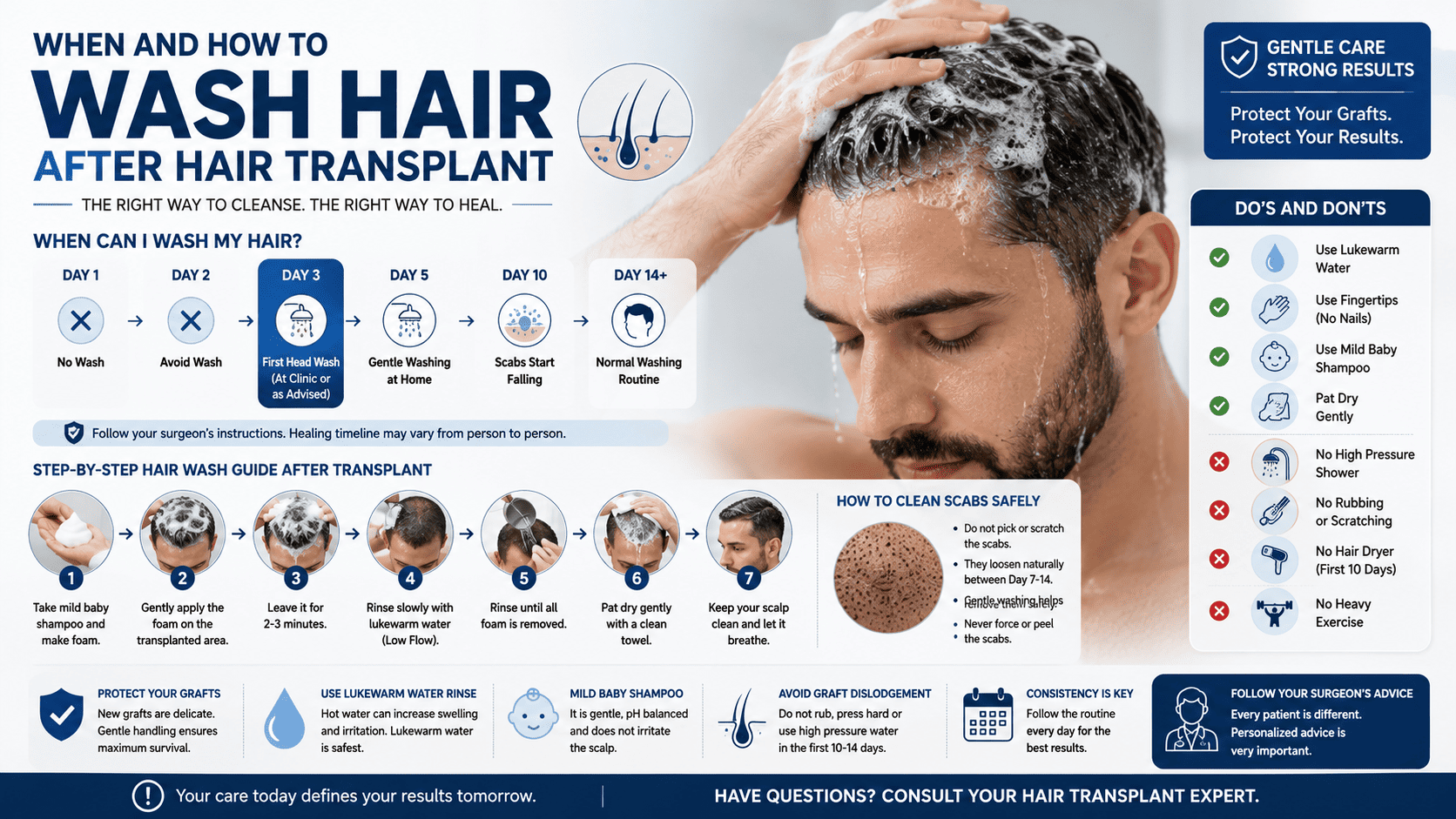
Hair Washing Timeline After Hair Transplant
The exact timeline varies among clinics, but the following schedule provides a general guideline.
| Day | Recommendation |
| Day 1 | Avoid washing |
| Day 2 | Follow your surgeon's instructions |
| Day 3 | First gentle wash in many cases |
| Day 4–7 | Continue careful cleansing |
| Day 8–10 | Gradual scab removal |
| Day 14 | Resume normal washing techniques |
This is a general industry guideline. Your own first-wash day may be earlier or later depending on your clinic's protocol — always go by the specific day your surgical team gives you.
First Head Wash After Hair Transplant
The first head wash after a hair transplant is extremely important because it sets the foundation for the recovery process.
Many clinics prefer to perform the first wash themselves so that patients can observe the correct technique.
Your first wash should include:
- Gentle application of foam shampoo.
- Minimal touching of the transplanted area.
- Low-pressure rinsing.
- Careful drying.
Never scratch or rub the scalp.
How RQC Performs Your First Hair Wash
At RQC Hair Transplant Clinic, the first dressing and hair wash is complimentary for every post-surgery patient. Dr. Vivek Galani or a master surgeon personally guides you through this visit, checks your grafts, and answers any questions before advising you on how to continue washing at home.
You are also given an aftercare kit with your post-operative medications, a neck pillow, surgical caps, and a hydration spray to keep the implanted grafts moist between washes, along with a Post-Op Doctor Meet to make sure everything is healing as expected.
Step-by-Step Hair Wash Guide After Hair Transplant
The following process is commonly recommended.
Step 1: Wash Your Hands
Clean hands reduce the risk of contamination.
Step 2: Apply Foam Gently
Place the foam on the scalp instead of rubbing it vigorously.
Step 3: Allow the Foam to Sit
Leave the foam in place for several minutes.
Step 4: Perform a Lukewarm Water Rinse
Avoid both very hot and very cold water.
A lukewarm water rinse is generally the safest option.
Step 5: Dry Carefully
Gently pat the scalp dry with a clean towel.
Avoid rubbing.
Hair Washing Flowchart
Wash hands
↓
Apply foam shampoo
↓
Wait a few minutes
↓
Lukewarm water rinse
↓
Pat dry carefully
Washing Transplanted Scalp Safely
The goal during the first few days is simple:
Clean the scalp without disturbing the grafts.
Important precautions
- ✔ Use your fingertips gently.
- ✔ Avoid scratching.
- ✔ Avoid strong water pressure.
- ✔ Avoid aggressive massage.
- ✔ Avoid prolonged sun exposure.
- ✔ Follow your clinic's instructions.
Avoid these mistakes
- ✘ Hot water
- ✘ High-pressure showers
- ✘ Harsh shampoos
- ✘ Hair dryers with high heat
- ✘ Scratching the scalp
Hair Transplant Graft Care
The first ten days are extremely important because the grafts are still stabilizing.
Proper graft care includes:
- Sleeping with the head elevated
- Taking medications as prescribed
- Avoiding strenuous exercise
- Protecting the scalp from trauma
- Maintaining scalp hygiene
- Supporting recovery with biotin, zinc, and other essential nutrients recommended by your surgeon
Good hair transplant graft care significantly contributes to the final result.
Mild Baby Shampoo Versus Regular Shampoo
Patients frequently ask whether ordinary shampoo is safe immediately after surgery.
In most cases, surgeons recommend a mild baby shampoo during the initial healing phase.
Comparison Table
| Characteristic | Mild Baby Shampoo | Regular Shampoo |
| Fragrance | Minimal | Often stronger |
| Ingredients | Gentler | More aggressive |
| Scalp irritation risk | Lower | Higher |
| Early recovery suitability | Excellent | Less suitable |
How to Clean Scabs After Hair Transplant
Scab formation is a normal part of healing.
However, many patients become anxious when they notice them.
The important thing to remember is this:
Never forcefully remove scabs.
How to clean scabs safely
Days 1–3
- Leave the grafts undisturbed.
- Wash gently.
Days 4–7
- Continue gentle cleansing.
- Allow the scabs to soften naturally.
Days 8–10
- Gradually remove loosened scabs according to your surgeon's instructions.
Never do the following
- ✘ Pick the scabs.
- ✘ Use fingernails.
- ✘ Rub aggressively.
- ✘ Apply excessive pressure.
Hair Graft Dislodgement: What You Need to Know
Perhaps the biggest fear after surgery is hair graft dislodgement.
Fortunately, this is much less common than most patients believe.
Common myths
Myth: Water causes grafts to fall out.
Fact: Gentle washing does not remove healthy grafts.
Myth: Touching the scalp destroys every graft.
Fact: Careful handling is generally safe.
Myth: Every shed hair means graft failure.
Fact: Temporary shedding is expected.
Doctor's Advice
As hair transplant surgeons, we often see patients become more anxious about washing their hair than about the surgery itself.
Remember that gentle cleansing is part of the healing process. Most problems occur not because patients wash their hair, but because they wash it too aggressively.
Patience and proper technique are essential.
Meet the Doctor Behind This Advice
This aftercare guidance reflects the protocol followed at RQC Hair Transplant Clinic under Dr. Vivek Galani, founder and chief hair transplant surgeon at RQC. Dr. Galani trained under specialists in Turkey, the USA, Portugal, and Spain, including Sapphire FUE training in Turkey (awarded by Dr. Tayfun Oguzhoglu) and Scalp Micropigmentation training recognised by Dr. Fernando Cortes (USA) and Dr. Miguel De Silva (Portugal). This internationally trained expertise shapes every stage of care at RQC — from the procedure itself to the graft-care instructions patients receive afterward.
Common Mistakes Patients Make
| Mistake | Possible Consequence |
| Scratching the scalp | Graft damage |
| Using hot water | Irritation |
| Rubbing vigorously | Bleeding |
| Delaying washing excessively | Excessive scabbing |
| Using harsh shampoos | Dryness and discomfort |
Final Thoughts
Learning how to wash your hair after a hair transplant is an important part of the recovery process.
The key principles are straightforward:
- ✔ Be gentle
- ✔ Use a mild shampoo
- ✔ Perform a lukewarm water rinse
- ✔ Follow your surgeon's instructions
- ✔ Avoid rubbing or scratching
- ✔ Allow scabs to fall off naturally
With proper care and patience, your newly transplanted hair can heal comfortably and continue progressing toward excellent results.
If you're preparing for a hair transplant in Surat or recovering from one, the RQC Hair Transplant Clinic team — led by Dr. Vivek Galani — provides complimentary first hair wash guidance, a full aftercare kit, and CareBuddy support from day one to help you heal with confidence.
