Recent Posts
Why Does Hair Fall Increase During Summer Season?
Aug 25, 2026Why Does Hair Fall Increase During Summer Season?
As soon as summer arrives, many people notice something unusual. They see more hair on their pillow, more strands in the shower drain, and more hair accumulating on their comb.
This naturally raises an important question:
"Why do I lose more hair during summer?"
The good news is that, in many cases, this increase in shedding is temporary. However, summer can also worsen existing hair loss conditions if the scalp is not cared for properly.
Higher temperatures, increased sweating, humidity, dehydration, excessive sun exposure, and changes in the hair growth cycle can all affect the scalp and hair.
If you're searching for:
- Fall Increase During the Summer
- seasonal hair loss causes
- summer hair care tips
- scalp sweat and hair fall
- humidity hair loss prevention
- how to stop hair fall in summer naturally
- best summer hair fall treatment options
- how sun damage affects hair roots
- why do I lose more hair during summer
- UV radiation damage
- scalp humidity and oiliness
- seasonal shedding phase
This guide will help you understand what is happening and what you can do about it.
Quick Answer
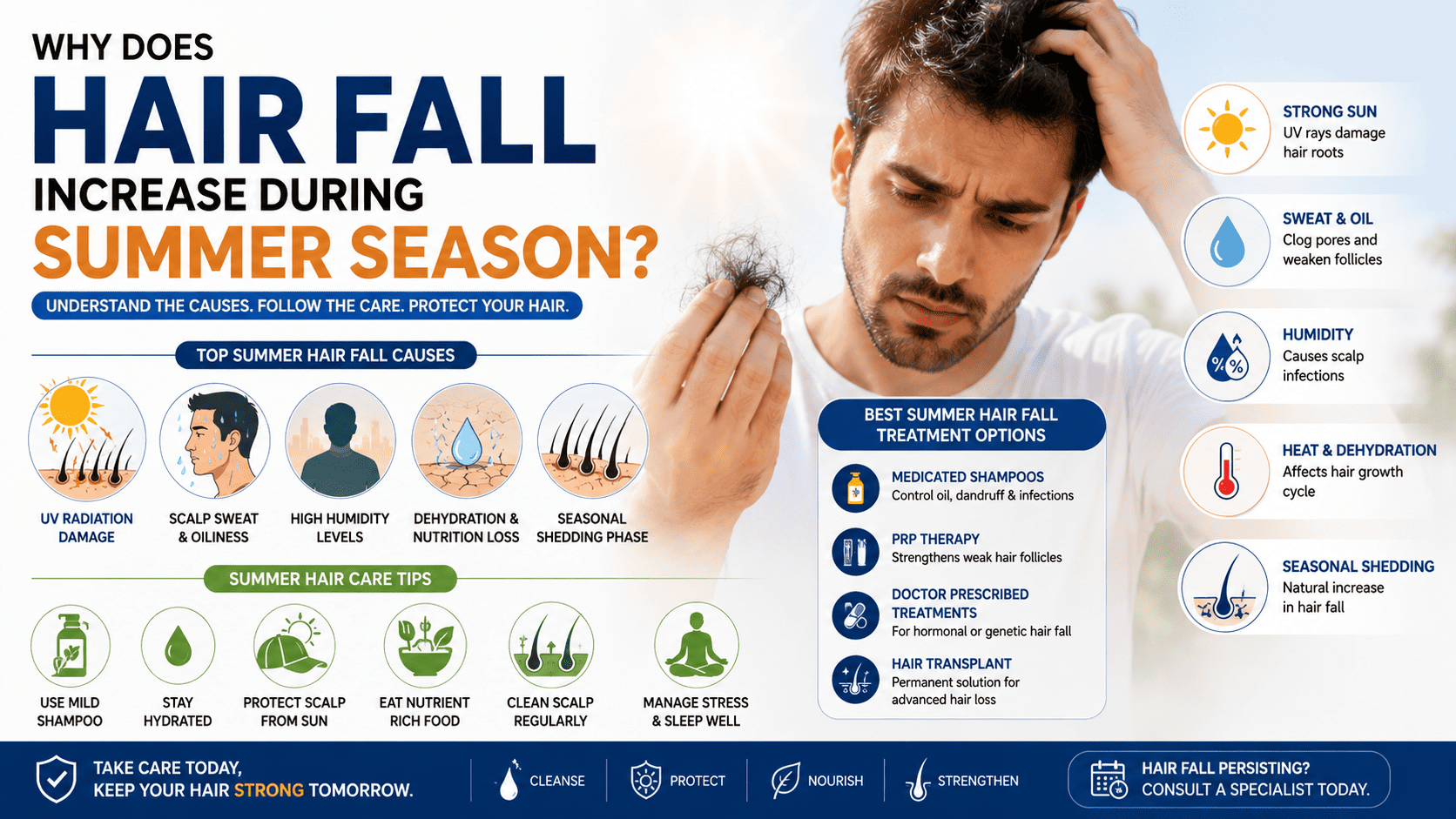
Yes, hair fall may increase during summer in some individuals. Excessive sweating, increased exposure to ultraviolet (UV) radiation, dehydration, scalp inflammation, and seasonal changes in the hair growth cycle can all contribute to increased shedding.
Fortunately, proper scalp care and early treatment can often help control the problem.
Does Summer Really Cause Hair Fall?
The answer is both yes and no.
Summer itself does not directly destroy hair follicles. However, several summer-related factors can create an environment that increases hair shedding.
These include:
- Increased sweating
- Excessive sun exposure
- Increased scalp oil production
- Dehydration
- Scalp irritation
- Seasonal changes in the hair cycle
For people who already have genetic hair loss, these factors may make the condition appear worse.
Understanding the Hair Growth Cycle
Before discussing summer hair loss, it is important to understand the normal hair cycle.
Every hair follicle continuously moves through different phases.
Anagen Phase (Growth)
↓
Catagen Phase (Transition)
↓
Telogen Phase (Resting)
↓
Exogen Phase (Shedding)
↓
New Hair Growth
Because different follicles are in different phases simultaneously, losing some hair every day is completely normal.
Seasonal Hair Loss Causes
Several factors contribute to increased hair fall during the summer months.
1. Increased Sweating
The scalp contains numerous sweat glands.
During summer, increased sweating can lead to:
- Dirt accumulation
- Excessive oil production
- Scalp irritation
- Itching
- Inflammation
2. Excessive Humidity
Humidity can create a warm and moist environment that encourages the growth of microorganisms on the scalp.
This may contribute to:
- Dandruff
- Follicle irritation
- Increased oiliness
3. Ultraviolet Radiation
Prolonged sun exposure may damage both the scalp and the hair shaft.
4. Dehydration
Water is essential for healthy skin and scalp function.
Insufficient fluid intake may worsen dryness and affect hair quality.
5. Seasonal Shedding
Research suggests that seasonal fluctuations may influence the natural hair cycle.
Some individuals may notice increased hair shedding at certain times of the year.
Seasonal Hair Loss Causes: Quick Overview
| Cause | Effect on Hair |
| Increased sweat | Irritation |
| Excessive oil production | Blocked follicles |
| UV radiation damage | Dryness |
| Humidity | Dandruff |
| Dehydration | Reduced hair quality |
| Seasonal shedding phase | Temporary hair loss |
Scalp Sweat and Hair Fall
Many people assume that sweat itself causes baldness.
Fortunately, that is not true.
However, scalp sweat and hair fall can be indirectly related.
How excessive sweating affects the scalp
Heat
↓
Sweating
↓
Oil accumulation
↓
Scalp irritation
↓
Inflammation
↓
Increased shedding
Sweat can also mix with dust, bacteria, and dead skin cells, increasing irritation.
Signs that excessive sweating may be affecting your scalp
- ✔ Persistent itching
- ✔ Oily scalp
- ✔ Dandruff
- ✔ Unpleasant odor
- ✔ Increased hair shedding
Scalp Humidity and Oiliness
The scalp naturally produces sebum, which protects both the scalp and the hair shaft.
During summer, however, humidity and heat can increase oil production.
Common symptoms
- Greasy scalp
- Itching
- Sticky hair
- Flaking
- Follicle inflammation
People with dandruff often notice that their symptoms become worse during summer.
How Sun Damage Affects Hair Roots
Excessive sun exposure can affect both the scalp and the hair shaft.
UV radiation damage may cause:
- Increased dryness
- Loss of natural shine
- Hair shaft weakness
- Increased breakage
- Protein degradation
UV radiation damage pathway
Sunlight
↓
UV exposure
↓
Protein damage
↓
Loss of moisture
↓
Weak hair shaft
↓
Hair breakage
Although hair roots are usually protected beneath the skin, prolonged scalp inflammation may negatively affect overall scalp health.
Why Do I Lose More Hair During Summer?
This is perhaps the most common question patients ask.
This is perhaps the most common question patients ask.
Several reasons may explain this phenomenon:
Normal reasons
- ✔ Seasonal shedding
- ✔ Increased washing frequency
- ✔ Longer hair growth cycles
Concerning signs
- ✘ Rapid thinning
- ✘ Visible scalp exposure
- ✘ Widening hairline
- ✘ Patchy hair loss
- ✘ Severe itching
If these symptoms occur, professional evaluation may be necessary.
It is also worth knowing that sudden, heavier shedding is not always seasonal. Illnesses involving high fever, such as viral infections, can trigger a temporary condition called telogen effluvium a few months later, which looks similar to seasonal shedding but has a different cause. A hair specialist can help you tell the two apart.
Summer Hair Care Tips
Protecting your hair during summer does not have to be complicated.
Essential summer hair care tips
1. Keep your scalp clean.
Sweat, oil, and dirt accumulation should be removed regularly.
2. Stay hydrated.
Adequate water intake supports overall scalp health.
3. Avoid excessive heat styling.
Hair that is already exposed to sunlight should not be subjected to additional heat damage.
4. Use a mild shampoo.
A gentle cleanser helps maintain the natural scalp barrier.
5. Protect your scalp from direct sunlight.
Caps and hats can provide additional protection.
Humidity Hair Loss Prevention
Humidity cannot always be avoided, but its effects can be reduced.
Recommended strategies
- ✔ Maintain proper scalp hygiene.
- ✔ Use medicated shampoos when appropriate.
- ✔ Wash the scalp regularly.
- ✔ Avoid heavy oil application.
- ✔ Consume a balanced diet rich in protein.
How to Stop Hair Fall in Summer Naturally
Many people prefer natural methods before seeking medical treatment.
Natural measures include:
- Proper sleep
- Stress management
- Protein-rich nutrition
- Regular exercise
- Adequate hydration
- Avoiding smoking
These steps can improve overall hair quality and support healthy growth.
Best Summer Hair Fall Treatment Options
Treatment depends entirely on the underlying cause.
| Condition | Treatment Option |
| Dandruff | Medicated shampoo |
| Nutritional deficiency | Dietary correction |
| Early hair thinning | PRP therapy |
| Pattern hair loss | Medical treatment |
| Advanced baldness | Hair transplant |
Identifying the cause is often more important than choosing a treatment.
At RQC Hair Transplant Clinic, treatment is matched to the actual cause after a scalp evaluation. Depending on what is found, this may include PRP Hair Treatment to stimulate weak follicles, medicated shampoos containing ketoconazole, salicylic acid, or zinc pyrithione for dandruff and scalp health, or doctor-prescribed Minoxidil and Finasteride for early-stage thinning. A personalised plan is only given after a proper consultation, since self-medicating for hair fall is not recommended.
Myth vs Fact
| Myth | Fact |
| Sweat causes baldness. | Sweat itself does not destroy follicles. |
| Washing hair daily causes hair loss. | Gentle cleansing may help maintain scalp health. |
| Sunlight permanently destroys every follicle. | Most damage affects the hair shaft rather than the follicle. |
| Summer hair loss always indicates baldness. | Seasonal shedding is often temporary. |
Doctor's Advice
Many patients become concerned when they notice more hair shedding during summer.
In most cases, the problem is temporary and manageable. However, increased shedding can sometimes reveal an underlying condition such as androgenetic alopecia, nutritional deficiencies, dandruff, or scalp inflammation.
If hair loss persists for several months, seeking professional advice is recommended.
This advice reflects the approach followed by Dr. Vivek Galani, founder and chief hair transplant surgeon at RQC Hair Transplant Clinic, Surat, where every patient's hair fall is evaluated for its actual cause before any treatment is suggested.
Key Takeaways
✔ Summer may temporarily increase hair shedding.
✔ Sweat, humidity, dehydration, and ultraviolet radiation are common contributing factors.
✔ Seasonal shedding is often normal.
✔ Proper scalp care can minimize the effects of summer-related hair loss.
✔ Persistent thinning should be evaluated early.
Final Thoughts
If you've ever wondered, "Why does hair fall increase during the summer?", you are certainly not alone.
Fortunately, understanding the relationship between scalp sweat and hair fall, UV radiation damage, humidity, and the seasonal shedding phase can help you take the right steps at the right time.
The earlier you identify the cause, the easier it becomes to protect your hair and maintain a healthy scalp throughout the summer season.
If your shedding feels heavier than usual this summer, the team at RQC Hair Transplant Clinic can help you find out why with a personalised consultation.
